Showing posts with label suicide. Show all posts

Sunday, 25 December 2022

Thinner, book review. (Stephen King)

A book with a very distinct message this one, and it's showing its age, too.
Like a lot of King novels (this one was originally released under his pseudonym Richard Bachman by the way), Thinner has a magical realism to it - the world ticks by and all is nice and normal, as it would be for you and I on any given day, but with a twist, a curse, an old Gypsy curse in this case, and it's one of my favourite things about this author's books. Everything is so normal bar that one thing: be it an ancient alien monster that dresses like a clown, a door in time that might help prevent the assassination of John F. Kennedy, or an old man living with a seventy year old mouse, reality is only ever skewed just a little.
Having killed an old Gypsy woman who stepped out in front of his car (he was concentration on his wife's hand down his pant rather than the road), and the police chief and local Judge whitewashing the whole affair, William (Bill) Halleck walks away, scot-free - well, he would have if the old Gypsy, Lemke, hadn't brushed his cheek on the courthouse steps and whispered that one word: Thinner.
The weight starts to drop off immediately, and the first half of this book is all about his cloths getting baggy, seeing his doctor, friends and colleagues, who, along with his wife and daughter, think it's a good thing but then start to worry, all whilst Bill is in denial, pretending to himself that he didn't hear what Lemke said. The second half is Halleck on the road searching for the Gypsy, tracking him down, and it is the better half, more fluid, emotional, but it's also where the age of the book starts to show.
The writing on a whole is okay, some of the latter chapters almost reach excellence, but when Halleck thinks of his teenage daughter as having 'coltish legs' and a random stranger unnecessarily uses the N word amongst the many other racist slurs against Gypsies, you begin to realise how times have changed.
That disappointment aside (it was written in the mid 80s - which is NOT an excuse by the way but a possible reason), the last hundred pages fly by, and as tensions rise and Halleck's weight plummets (he was 255 at the beginning, now down to 115), and the ending nears - which I won't spoil - the message I referred to at the beginning becomes blatantly clear.
Treat people how you would like to be treated.
Whether it's yourself, your loved ones, neighbours and strangers alike, and take responsibility for your actions. Think before you speak but speak anyway, but be honest, with yourself and those around you, because if you don't, something terrible could happen, something terrible like . . .
Three stars for Thinner then but only just, and no surprise that it was first published under his pseudonym.

Don't forget to search my blog for your favourite authors and books and if I haven't read them, message me with your recommendations.

Sunday, 31 October 2021

The Haunting of Hill House, book review. (Shirley Jackson)

Another reread and another 'Glad I did' moment when I finished.
On first acquaintance I felt this book rather lacklustre - I cut my teeth on James Herbert and progressed to Susan Hill remember - but something niggled.
I saw reviews on Goodreads championing the book, Bookstagramers on Instagram rating it highly and then, a Netflix series, which got me thinking: what had I missed?
So, as 2021 is the year of the reread, I added it to my list.
The story begins with a Dr Montague having written to numerous individuals across the country who either think they have, or have actually witnessed 'something special', for assistance in an experiment he wishes to conduct, and so he invites them to Hill House, which he has agreed to lease for the summer in order to gain as much evidence as he can that paranormal activity exists - Hill House is widely regarded as one of the most haunted houses ever.
One of the terms of said lease is that Luke Sanderson, the heir to the house, is present, so when Eleanor (who has recently lost the mother she cared for, for most of her life) and Theodora (who is rather bohemian), arrive, being the only two who responded to the doctor, most of the cast is assembled.
The story builds slowly but not too slowly, introducing the characters gradually - and they're all different enough to have a depth and personality of their own and develop little by little throughout the narrative, revealing, right up to the very last pages their strengths and weaknesses. Later, Dr Montague's rather overpowering wife and her side kick, Arthur Parker arrive at the house and add an element of flair to proceedings. Add to that, Mrs Dudley - who doesn't stay at Hill House after dark and sets breakfast at 9, lunch at 1 and dinner at 6, but flitters almost ghostlike in and out of rooms, the house and the narrative, and an element of intrigue is created and one can't help but speculate as to what is real and what is not.
Much of the tension in the book is implied and, rightly or wrongly, I decided that the rattling of doors and thumping of walls was all in Eleanor's head, or she somehow manifested them, as others only seemed to witness it when they were with her, which got me thinking: maybe she was the conduit for the spirits, the reason there was something to witness at all, and had she not been there, whether the others would have spent a rather serene but (from a paranormal activity perspective), rather disappointing summer in an old remote house?
With the book ending the way it did (no spoilers as usual), with Eleanor being ostracised, forced to leave, separated from the others and Hill House - or was she? - I felt I might have got to the crux of this novel, but of course, many of you may disagree or, like me when I first read it, not have analysed it so deeply.
All the same, three and a half stars for this slightly creepy haunted house novel and a better experience than my first read.
Enjoy, and happy Hallowe'en.

Don't forget to search my blog for your favourite authors and books and if I haven't read them, message me with your recommendations.

Saturday, 26 December 2020

The Midnight Library, book review. (Matt Haig)

There was a lovely moment when I neared the halfway point of this book, a light bulb moment if you will, when I didn't so much know how it would end but knew how it would end!
To clarify: the finer details were still a mystery of course and would be until the very last page, but the general premise, where Nora Seed (who had just lost her cat - dead - her job - economic downturn - hadn't heard from her best friend in ages and so, believed there was little else to live for) would end up. Whether she would find her perfect life, the one she should have lead from her first beginning - be it the fame of a world renown rock band, being able to hold an audience with the perfect rendition of a Mozart concerto, holding the world and Olympic record for the four hundred meters breaststroke, or surviving the extreme climes of the coldest places on earth as a glaciologist - I had the answer.
Although I was but halfway through, knowing what was going to happen - or at least thinking I did - did nothing to lesson my enthusiasm; if anything it help, fuelled me, pushed me to see if I was right, and when I found out that I was, again, it didn't matter, I felt no less cheated, it was exactly how it should have been and made for a better book.
With myriad scenarios at the author's disposal it could so easily have been different. He could have fallen by the wayside, been temped by vainglory and excess or dwelt on the pitiful and despair but instead he went with what in this humble readers opinion was, the right road. It was a bumpy one, there's no question about that, with many a precipice for our weary protagonist to have tripped and fallen down, but she didn't, she made it, made it to her final resting place, and there was just so much right about where that was.
The way Matt Haig writes here grabs you straight from the off ,and with short sharp chapters and Nora's contrasting lives of excess, fame, quiet solitude, helplessness, addiction and the very serious subject of loneliness, there wasn't a page turned that didn't reveal some new and intriguing facet of a life not lived and it became a very emotional journey.
You want Nora to live, to love, be loved, find her happiness, wherever that might lie but you want to shake her, too; shout at her for wanting to give up, but not once did I ever stop routing for her, through good decisions and bad I was loyal to the end because as I said at the beginning of this post, I had a sneaky suspicion I knew the outcome.
Thank you Matt Haig, for this book, which is my first taste of your work, for I truly enjoyed it and will be wholeheartedly recommending it to all. I will no doubt be acquiring your back catalogue over the coming months and look forward to whatever you come up with next.
Four star for The Midnight Library. An enjoyable but thought provoking book which, especially at this time of year, brings the very important subject of loneliness to the fore and it's just won the Goodreads book of the year for fiction, too, so go check it out; it does not disappoint.

Don't forget to search my blog for your favourite authors and books and if I haven't read them yet why not message me with your recommendations.

Monday, 25 July 2016

Girls on fire, book review. (Robin Wasserman)

Oh boy!
When I read the blurb on this one, I thought, okay, sound like this could get messy.
Rarely do I purchase a book, take it home and start reading it the same day; normally because I'm in the middle of reading something else, but not this time. 
Having just finished Stephen King's Revival, (see blog post 14th July) I was about to start a selection of short stories, but got sidetracked by 'Girls on Fire', diving in the moment I got home. (Well, I actually read the first few pages whilst sitting in my car, and I hadn't done that since I purchaser 'The Book Thief' by Marcus Zusak). 
So, to the characters. 
We have the loner, Dex, the beautiful prom queen, Nikki and we have the outsider, (read: bad influence) Lacey. 
This book is told mainly in the first person by Dex (real name Hannah Dexter), and Lacey. 
This is a story of teenage anger, peer pressure, drugs alcohol, Nirvana and sex, and things certainly start to burn quickly; alcohol is consumed in large quantities, drugs are smoked, sex is mostly consensual and the music is turned up to eleven. 
After the suicide of a well liked, well respected and very talented high school boy, Craig (who happened to be dating Nikki), Dex and Lacey are thrown together. 
The story runs on two timelines, the present, told by Dex, and the year before, told by Lacey, which (spoiler alert) gradually reveals how she had been having an affair with Nikki and her talented high school boyfriend. 
Lacey's voice speaks mostly from the past in almost apologetic reflection to Dex, as if she is writing a journal, and I though this worked well. 
The climax is sort of what I was expecting, but I don't think it was written with the intention of being a big secret, (Lacey gives too many clues as we journey through the book for that), but the very very end was a bit of a let down.
I suppose you can only have so much kindle for a fire, and when it's gone it's gone. Oh well!

Thursday, 5 November 2015

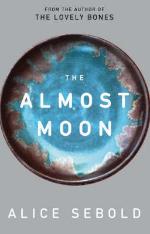
The Almost Moon, book review. (Alice Sebold)

Having purchased Alice Sebold's 'The Lovely Bones' for a work colleague and it receiving high praise, I decided to purchase 'The Almost Moon' when it cropped up in my local charity shop. 
The book is set over a single, twenty four hour period, and starts with Helen Knightly tending her mother. The tension between them is tangible and within a few chapters, Helen Knightly is a murderer. 
Sebold handles what is a very personal crime, with great skill. During the book, Helen seems to go from slightly deranged, she has sex with her best friends son (he's an adult), to being childlike, she confides in her ex husband that she's killed her mother, and everything in between, like going to work, which happens to be life modelling.
This is a short book, and an odd one too. The subject of matricide is one that I hadn't come across before, but an interesting one all the same; and as you read further, a history of agoraphobia and other mental illness's in the family are revealed. So, reasons for Helen's instability become apparent, and the author could easily have tried to justify the murder this way, but she doesn't, she just uses the past to explaining why Helen might have murdered her mother. 
So, a good little book then. Three and a half stars, but not four, so I'll settle on three.
Now all I have to do is borrow 'The Lovely Bones', which I saw on film but haven't read yet.