
Showing posts with label bookaholic. Show all posts
Showing posts with label bookaholic. Show all posts
Tuesday, 7 July 2020
Lies Sleeping, book review (Ben Aaronovitch)
The 'Little Crocodiles' was a group of unlicensed practitioners of magic formed by the now deceased and not much missed Geoffrey Wheatcroft when he was at Oxford in the 1950s, and as some of those members have proved rather deadly in the past, tracking down those who may or may not have been involved and finding out what they did or didn't learn, seems as good a place to start as any if Peter Grant is ever going to find the elusive Chorley, and so, the hunt is on.

Saturday, 27 April 2019
After the Fire, book review. (Will Hill)

The book follows Moonbeam's life (bear with me here) through a series of flashbacks and interviews conducted by Dr. Hernandez and Agent Carlyle. As the book progresses we get to hear more about what happened in the compound of 'The Lord's Legion' a religious cult that had isolated itself from the outside world until, well, until now, their perceived apocalypse.
Moonbeam and the surviving young members of the cult are in a hospital/gaol, exactly where Father John said they would be if they didn't sacrifice themselves for his god, so when they all meet in the rec room there are clashes: there is love, hate, fear and retribution which all adds to the realism of the narrative.
The book alternates between 'before' and 'after' chapters, which keeps the pages turning, and Moonbeam is both tough and vulnerable, never really believing the rhetoric of Father John but at the same time, doubting herself - wondering whether she should have died for his god.
I liked her internal battles: whether Dr Hernandez and Agent Carlyle could be trusted, whether her surviving would send her to hell, or gaol, or both, and as the novel moves on, we learn more about the changes that happened in the compound, the hardening of Father John's rhetoric, the increase in work and punishment that ended in Moonbeam’s mother leaving. Her sense of abandonment that follows, which inexorably leads to the grand finale, the battle between good and evil, is well executed, being fast furious and somewhat frightening, whilst retaining a good sense of reality.
So the characters are good, the story is different, has pace, so why only three and a half stars? It's silly things like Moonbeam's heart pounding in her chest all the time as if it might pound somewhere else, and when fire ignites everything the author adds, 'it came into contact with', which is totally unnecessary. If fire ignites everything, it ignites everything, you can leave it at that.
Moonbeam and the surviving young members of the cult are in a hospital/gaol, exactly where Father John said they would be if they didn't sacrifice themselves for his god, so when they all meet in the rec room there are clashes: there is love, hate, fear and retribution which all adds to the realism of the narrative.
The book alternates between 'before' and 'after' chapters, which keeps the pages turning, and Moonbeam is both tough and vulnerable, never really believing the rhetoric of Father John but at the same time, doubting herself - wondering whether she should have died for his god.
I liked her internal battles: whether Dr Hernandez and Agent Carlyle could be trusted, whether her surviving would send her to hell, or gaol, or both, and as the novel moves on, we learn more about the changes that happened in the compound, the hardening of Father John's rhetoric, the increase in work and punishment that ended in Moonbeam’s mother leaving. Her sense of abandonment that follows, which inexorably leads to the grand finale, the battle between good and evil, is well executed, being fast furious and somewhat frightening, whilst retaining a good sense of reality.
So the characters are good, the story is different, has pace, so why only three and a half stars? It's silly things like Moonbeam's heart pounding in her chest all the time as if it might pound somewhere else, and when fire ignites everything the author adds, 'it came into contact with', which is totally unnecessary. If fire ignites everything, it ignites everything, you can leave it at that.
There were numerous examples of this throughout the book and suffice to say it took the edge off of things. Sometimes, less really is more.
After the Fire isn't amazing then but it does have something worth exploring and as it's neither apocalyptic nor mystical/sci-fi, it differentiates itself from other Y/A books, which is good.
After the Fire isn't amazing then but it does have something worth exploring and as it's neither apocalyptic nor mystical/sci-fi, it differentiates itself from other Y/A books, which is good.
Sunday, 24 February 2019
The Colour Purple, book review. (Alice Walker)
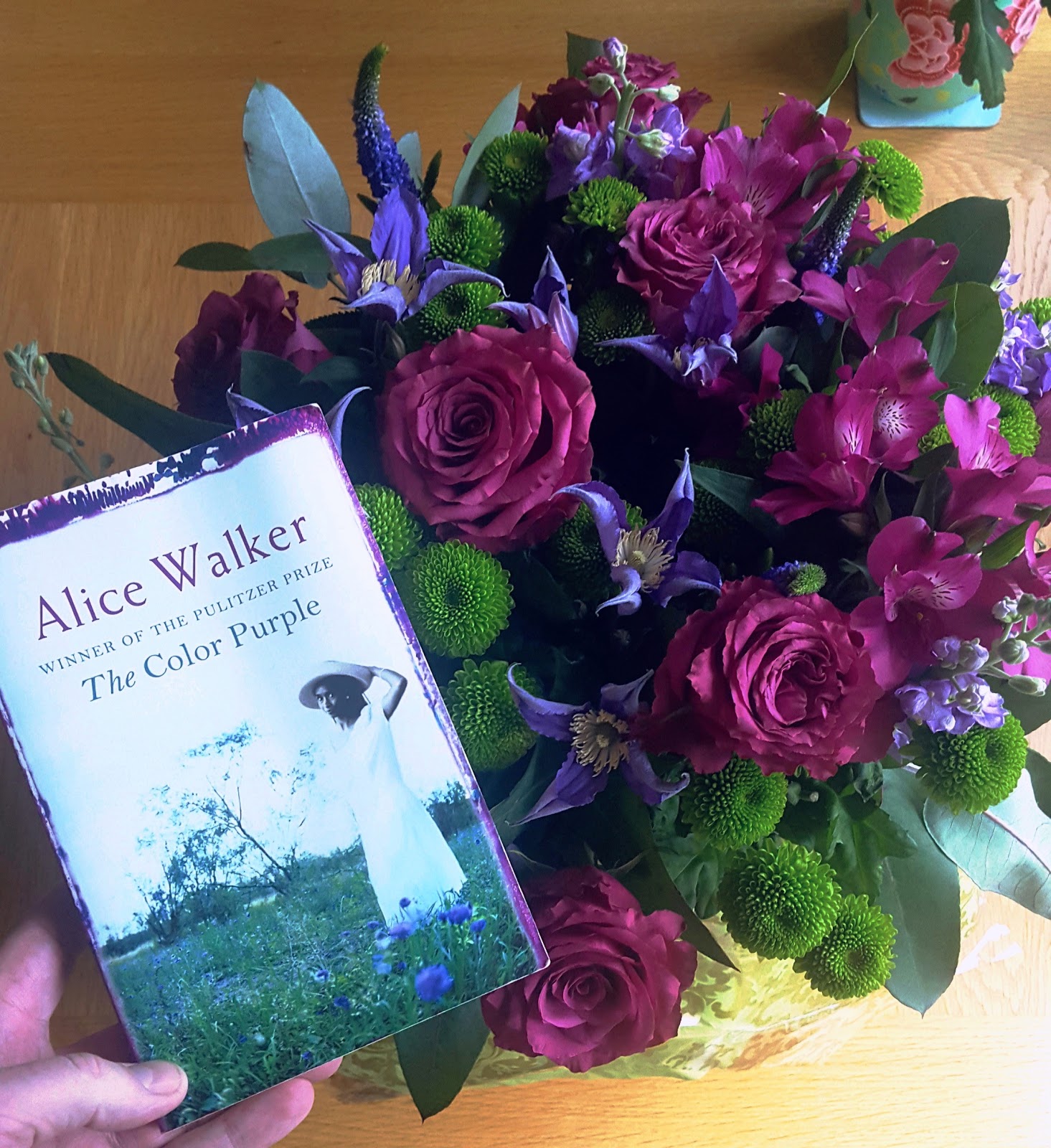
The pain of what Celie goes through in the book, the trials of a life with a father who rapes her, a husband who beats her, loves another woman, can only be described as a hard, wretched life, but forsaking all of this, Celie pulls through. She has her God and there is joy in friendship, love from family and music in her soul.
Born poor, black, and down south, Celie has little going for her, even her sister manages to escape her fate by having a good head on her shoulders and the ability to learn quickly, something Celie finds hard, and so, barely a teenager, Celie gives birth to her first child, fathered by her dad, and it doesn't stop there.
Told in a series of letters written by Celie, firstly to her God and then to her sister, Nettie and eventually from her sister back to her, The Colour Purple is a fiercely compelling book that has you at times on the edge of your seat. The letters from Nettie come from Africa where she has ventured as a missionary, and these were some of the highlights for me.
Not knowing whether Nettie would succumb to infection or disease whilst in Africa, whether Celie would ever see her sister's letters - her father intercepts them for many years - or whether Nettie would ever find out what Celie has had to endure in life, keeps the narrative flowing and the pages turning fast.
By reading this book you open yourself up to a roller-coaster of emotion: there will be tears, you will feel fear, hatred and anger, but as the book comes to a close you will feel a deep, deep respect for the main character and the author, for this is a journey that feels so real it could be autobiographical.
Praise be then for The Colour Purple. Four stars.
Told in a series of letters written by Celie, firstly to her God and then to her sister, Nettie and eventually from her sister back to her, The Colour Purple is a fiercely compelling book that has you at times on the edge of your seat. The letters from Nettie come from Africa where she has ventured as a missionary, and these were some of the highlights for me.
Not knowing whether Nettie would succumb to infection or disease whilst in Africa, whether Celie would ever see her sister's letters - her father intercepts them for many years - or whether Nettie would ever find out what Celie has had to endure in life, keeps the narrative flowing and the pages turning fast.
By reading this book you open yourself up to a roller-coaster of emotion: there will be tears, you will feel fear, hatred and anger, but as the book comes to a close you will feel a deep, deep respect for the main character and the author, for this is a journey that feels so real it could be autobiographical.
Praise be then for The Colour Purple. Four stars.
Sunday, 20 January 2019
Heart of Darkness, book review. (Joseph Conrad)

Sitting on a cruising yawl (a sailing boat
to you and I), in the Thames estuary, waiting for a flood to subside and the
tide to turn, Marlow - a seaman of some repute - recants the epic journey he
once took into the heart of the African rain forests; to the heart of darkness.
Just getting a commission was hard enough,
until a wealthy benefactor stepped in, and his passage from England to Europe
and then on to the African continent, took weeks, all before he had to battle
his way through the dense jungle of the Congo to discover 'his' steamer a
wreck.
A month or two pass whilst he repairs his
charge, making her seaworthy again, and then finally, he is able to press on,
up the Congo River in search of the legendary explorer and ivory thief, Mr
Kurtz.
With every mile travelled, the forest
encroaches, the air thickens and the natives get bolder. As a reader you feel the
tension build, the exhaustion and the sweat running down their backs, you hear the call of the birds, feel the humidity, as if you are right there in
the jungle, and you get nervous when you see, through dense undergrowth, eyes staring
back at you.
Heart of Darkness is a short book but the
writing is as fierce as the mosquito filled heat soaked African rain forest,
and as every meander in the river is traversed, the intensity rises and the
tension builds, leaving you somewhat exhausted by the end but wanting more.
Three and a half stars for this one then,
as it is good, builds tension well and has you on edge for a fair chunk of the
book, but I did feel a bit lost sometimes, which might be me, but there you go.
Saturday, 15 December 2018
Mark Haddon. (Author focus)

For my third author focus, I have chosen Mark Haddon, author of, The Curious Incident of the Dog
in the Night-time: the all-time classic, multi-million selling book, translated
into untold languages and made into a West End play, but his first book is not all that he's good for, he's not just a
one-trick pony.
I first read, The Dog in the Night-time, some years ago now
and then, when some of his other books came my way, I felt the need to delve
deeper, explore a little more and I'd encourage you to do the same, because, A
Spot of Bother is both funny, scary and sad all at the same time, and his
exploration into family life, how they interact, clash, fight, envy, love, is
spelled out in his third novel, The Red House, which again, is well worth a
read.
Then, his latest book, the collection of short stories that
is, A Pier Falls, (not my normal fodder), was quirky, inviting, strange and damned
right weird, but still had a certain something about it.
Haddon has a very unusual writing style, which at
first may seem strange, for there is a distinct lack of commas, semi-colons
and other punctuation, but his characters, his settings, his prose, soon
encapsulates you, pushing you through the stories, and I think it is his grasp
of the mundane, the quirks of human beings, the simple every day, that make his
books so readable, so down to earth and memorable.

Enjoy.
Saturday, 24 November 2018
Ready Player One, book review. (Ernest Cline)

Is sci-fi your thing? No.
How about
something apocalyptic, geeky '80's retro? Four hundred pages about gaming?
No! Still not on board?
Well, you’re gonna miss out on one hell of a good book then because, Ready Player One is fantastic.
It is 2044, we’ve used all the oil, there's widespread famine and poverty, but hidden in the OASIS, (a computer generated universe consisting of thousands of worlds), there's hundreds of billions of dollars waiting to be won. All you have to do is solve the riddles set out by its deceased creator, Halliday, find the keys to the three gates and it’s yours. Some seek the fortune for good, to prosper, not only themselves but others, but the IOI Corporation wants it for itself and will stop at nothing it seems to get it, including murder.
Living at the top of a twenty story stack of mobile homes with limited aspirations, other than to win the fortune, Wade Watts, aka, Parzival spends all his spare time logged into Oasis, trying to solve the riddles.
When he stumbles upon the first of the three gate keys, he becomes instantly famous, a target, once he's made it through the first gate, he's on borrowed time. His aunt and the trailer where they lived, are blown to pieces, there's coercion, a feigned suicide, proposed kidnappings and more.
No! Still not on board?
Well, you’re gonna miss out on one hell of a good book then because, Ready Player One is fantastic.
It is 2044, we’ve used all the oil, there's widespread famine and poverty, but hidden in the OASIS, (a computer generated universe consisting of thousands of worlds), there's hundreds of billions of dollars waiting to be won. All you have to do is solve the riddles set out by its deceased creator, Halliday, find the keys to the three gates and it’s yours. Some seek the fortune for good, to prosper, not only themselves but others, but the IOI Corporation wants it for itself and will stop at nothing it seems to get it, including murder.
Living at the top of a twenty story stack of mobile homes with limited aspirations, other than to win the fortune, Wade Watts, aka, Parzival spends all his spare time logged into Oasis, trying to solve the riddles.
When he stumbles upon the first of the three gate keys, he becomes instantly famous, a target, once he's made it through the first gate, he's on borrowed time. His aunt and the trailer where they lived, are blown to pieces, there's coercion, a feigned suicide, proposed kidnappings and more.
As riddles get solved, an epic game of
Pacman is played, tempers fray and trust issues arise, you forget you’re in a
fictional world within a fictional world and get pulled along for the ride, and
all the while the characters in the book are, for the most part, avatars in a computer
game.
Parzival is super geeky, but he's educated himself through the OASIS school system, his fellow gunters, (people who spend their time in OASIS looking to solve Halliday's riddles, but who haven't sold out to the corporation of IOI), all bring something different to the narrative, some more than others, of which we find out at the end of the book!
The author’s love of the 1980's was right up my street and some of the games, the computers, and most of the films he makes reference to - Parzival flies around in a DeLorean for goodness sake's - had me reminiscing, and there's always a sense that something's not quite right, that one of the gunters might not be telling the whole truth. With that in mind, the sixers (derogatory name for those who spend their days trying to crack the riddles in OASIS for IOI), gradually close in on Parzival and his friends but, can they beat them to Halliday's Egg and win the prize - Ownership of the entire virtual word, the Oasis?.
Parzival is super geeky, but he's educated himself through the OASIS school system, his fellow gunters, (people who spend their time in OASIS looking to solve Halliday's riddles, but who haven't sold out to the corporation of IOI), all bring something different to the narrative, some more than others, of which we find out at the end of the book!
The author’s love of the 1980's was right up my street and some of the games, the computers, and most of the films he makes reference to - Parzival flies around in a DeLorean for goodness sake's - had me reminiscing, and there's always a sense that something's not quite right, that one of the gunters might not be telling the whole truth. With that in mind, the sixers (derogatory name for those who spend their days trying to crack the riddles in OASIS for IOI), gradually close in on Parzival and his friends but, can they beat them to Halliday's Egg and win the prize - Ownership of the entire virtual word, the Oasis?.
There is a huge amount of info-dump throughout this book, which gets a bit annoying but with the epic battle at the end, the tense
week that preceded it, the journey through the various challenges, great characters and (for me anyway), the books effortless mix of nostalgia with a possible future and superb
researching and originality, it easily earns four stars.
I just hope the film doesn’t let it down.
Don't forget to search my blog for your
favourite authors and books and if I haven't read them, message me with your
recommendations
Monday, 15 October 2018
IT, book review. (Stephen King)
 |
| My 1st edition and film tie-in copy along with themed T |
O! M! G!
This book is hard for me to
review objectively because IT and I have history. (See what I just did there?). I've read it before you see, twice in fact. The first time, when I was young, closer in age to the kids in
the book, I saw things from their perspective and then,
as I got older, I related to the adults more, and now, on my third
visit, well, I just feel for them all.
This epic book runs to one thousand one hundred and sixty-six pages and has
such depth, not just in the characters but in the history of the town in which they live, that in spite of its length, it has pace, firing you out from one chapter to the next.
You read the first fifty
pages and you're hooked, the next two hundred pass in a blur of excitement, of
reunion, of horror, and then, before you know it, you're half way through but still, new things
are happening. Like the shootout in front of the pharmacy in broad daylight,
where half the town came armed and ready to kill. The explosion of 1906
that killed 88 kids on an Easter egg hunt. The great flood that washed half the town away decades before and of course, the realisation that every
twenty-seven years kids go missing, die left, right and centre, but with
no one seeming to noticing, seeming to care. And why don't they notice, why
don't they care?
IT . . . that's why.
IT has a hold over the town
of Derry. People turn a blind eye, forget, dismiss, delude themselves that
the missing and the dead left town, were trouble makers, fell out with
their families, anything but admit the truth, but in the summer of '58', just
as they break for summer vacation, seven kids become friends, become The
Losers, and one of them, stuttering Bill, who lost his brother in the fall of
'57', has a score to settle, a score that may well take him twenty-seven years to
fulfil.
 |
| My copy from 1986 |
To give this book a star rating any less than six out of five would be a travesty, but as we're governed by convention I will have to settle for five.
If you haven't yet taken a journey to Derry, never been to the Barrens and met Henry Bowers, been in the thick of an apocalyptic rock fight, smelt the scorched remains of the Black Spot, been chased from 29 Neibolt street by a leper, a werewolf or Pennywise the dancing clown, you’ve never really lived.
Put simply, one of the greatest books I have ever read.
Sunday, 30 September 2018
The Trial, book review. (Franz Kafka)

Okay then, Kafka's, The Trial,
was exactly that to read, a trial; of my patience, my sanity and my time.
If this was dystopian or Sci-Fi, it might make more sense, but as far as I could tell, the book was set at the time
it was written and in Europe, not some skewed alternate universe, which was
how the book read.
Josef K is arrested at his home
but not told by the guards why. Nor is he told by their supervisor or anybody
else for that matter, so he goes through the entire book not knowing who has accused
him of what and with no idea of how to defend himself.
He meets random people in lofts
(court chambers that double as people’s bedrooms), an advocate
who's been working on another man's case for five years with no resolution, a priest who seems
to know him and his case, but not enough to actually tell him anything useful, and
several women who are all attractive, and become instantly attracted to him!!!
On top of this, you get
paragraphs that extend to over a page where two or more
people are talking about multiple topics, and I had to
wonder, if anyone else wrote something as disjointed as this book, whether they would they ever get it published? (That’s a No by the way).
I know that some of you might
take umbrage at my views, that some of you are far more intelligent than me, (or
smoked the right drugs), and will say that I just didn’t get it, but I would
question, what is there to get? To me the whole thing was just one big
confusion, where no-one seemed to know what the hell was going on, and another
thing, everyone seemed to be poor, even Josef K, a successful banker, lived in
a small rented room in a tenement building, as did the advocate, which again,
made me wonder whether this book should be dystopian.
Anyway, in conclusion: don’t bother
with Kafka’s, The Trial, read something else.
Friday, 31 August 2018
Ian McEwan. (Author focus)

With, The Children Act, hitting the cinema
this week, I thought it apt to do my next author focus.
So, for this post, Ian McEwan, author of
the aforementioned, and such books that you may recognise from previous
visits to the cinema as, Enduring Love, with Daniel Craig and Rhys Ifans,
On Chesil Beach with Saoirse Ronan and of course, Atonement with Vanessa
Redgrave and Keira Knightley, and, let’s not forget last year's excellent BBC
adaptation of, The Child in Time, with Benedict Cumberbatch.
So, it's fair to say that at some time or
another, most of you would have come across something written by this author,
but, how many of you have actually read one of his books?
I confess that the extent of my reading is
what you see in the picture on the left, so, no Atonement then, and I've yet to read his
latest novel, but most of what I have read, I have enjoyed - some more than others of
course.
Solar, was one that I didn’t really get on
with, along with, The Daydreamer, but Sweet Tooth was excellent, capturing the
dim, smoke filled offices and soot covered buildings of the 1970's very
convincingly and along with Saturday, which takes us through one particular
Saturday in the life of an eminent neurosurgeon, from a mundane traffic
collision, through an epic squash match, to a climax that had me reading at
double speed, they rank as my favourite McEwan books to date.
His novels aren't long, (so no excuses),
with most not even making three hundred pages, and they can lack a bit for
their brevity, but what you do get is an intense ride, intense characters and
in some cases - Enduring Love being the one that really stands out for me -
something that sticks with you. (The appendix in Enduring Love is worth buying
the book for alone).
So, whether you like books narrated by a foetus,
a child who time travels, young married couples who fear intimacy, or raving madmen
who become infatuated, there seems to be something for everyone here, and
hopefully, as long as McEwan keeps writing, we’ll get some excellent viewing
pleasure too.
So, the film: Emma Thompson in the lead
role, Ian McEwan as the writer, set in my old home town of London, what more
could I want? (Maybe I'll let you know once I've seen it).
Monday, 20 August 2018
All Hell Let Loose, book review. (Max Hastings) (Warning! Content some may find upsetting).

Along with, James Holland and Antony Beevor, Max Hastings is
one of only a few non-fiction authors I have read more than
once, and for good reason. His narrative is a mixture of cold hard facts, the death, destruction and destitution that comes with war, spliced with first
hand testimony of those that fought in the fields, the streets, on the landing
grounds, and with growing confidence and strength in the air, (thank you
Winston), so our island, Europe, and millions of others around the world,
could be free from tyranny.
The author also gives voice to those who
never took up arms, the housewives, the land girls, WRENS, and some of the
millions of refugees, and although I'm not going to discuss the cruelty
that fellow humans inflict on those with the wrong bloodline, ethnicity, creed
or beliefs, in this blog post, (you can read the book for that), what I will say
is that Max Hastings' writing and research is truly amazing, humanising a book
that is so full of depravity, that at times I questioned whether I wanted to continue.
This book charts the whole of World War II,
from the phoney war of 39’ – 40’, to Japan's capitulation in 1945, from the
tiniest islands in the Pacific, to the blood drenched streets of Stalingrad,
and it is horrific beyond imagination. To put some sort of perspective on
that, I'm going to ask you to visualise something.
Think back to the last time you sat in a
packed cinema, the last football game you attended, rock concert maybe, and
picture the crowd. How many people were there? 500? 2000? Maybe it was a
stadium with 50,000, or a music festival with 100,000. Whatever the amount, fix
that crowd in your mind.
Now, picture this: Between the 3rd
September 1939 (the day Britain and her allies declared war on Germany remember) to the
14th August 1945, that's 2172 days, (or 5 years, 11 months and 11 days), and
with your crowd in mind, how many people do you think died for every one of
those days, on average?
Not maimed, or injured, raped or beaten,
not starved or displaced, but killed.
Twenty seven thousand! That's, twenty seven thousand
people dying, every day, for two thousand seven hundred and seventy-two days,
consecutively.
If you takes just one thing from this book,
it's how powerful the human spirit is, that when there is no hope, when there is mass genocide, rape, torture,
starvation and deprivation beyond anything we can ever imagine, men, women and
children manage to cling on and survive.
LET US NOT FORGET THAT SHALL WE. LET US
NOT DO THIS AGAIN.
Thursday, 2 August 2018
Where do you edit? Confessions of a serial editor!!

Oh editing!
I could write a lot about editing: how it sometimes makes sense, where other times it doesn't, how it gives and takes, highlighting your mistakes one minute, underlining the quality of your work the next, but where would we be without it?
When I reread some of the things I've written in the past, they make me laugh, some even have me squirming; some make me wonder what illegal substance I must have consumed when writing them, because from a literary point of view, they make such little sense, but, getting your work down, scribbling those notes whilst on the train in the morning, during your lunch hour, adding a memo on your phone, or taking a photograph that will jog your memory later, are all so, so important, because a novel, a poem, the short story or novella that you are nursing, isn't going to write itself.
So, where should you edit?
For me, it's in the backroom, the lounge, kitchen or bedroom, the car, the common, or in a field. It's at work, on holiday or in the dead of night and because we all lead such busy lives, (some more so than others), I find those little moments wherever I can, so when people ask me how I find the time to write, (after all, ninety thousand words don't just fall onto the page), I can tell them.
I confess that I don't watch the television much, that I'm able to spend most of my lunchtimes undisturbed, and if you add in a few hours here and there, on a Sunday or a day off, it all adds up.
It's not as much as I would like, (will it ever?) but I take what I can get, and I'd encourage you all to do the same, 'cause once it's on the page, set down for you to see, you can start the real writing . . . the editing.
Good Luck.
For me, it's in the backroom, the lounge, kitchen or bedroom, the car, the common, or in a field. It's at work, on holiday or in the dead of night and because we all lead such busy lives, (some more so than others), I find those little moments wherever I can, so when people ask me how I find the time to write, (after all, ninety thousand words don't just fall onto the page), I can tell them.
I confess that I don't watch the television much, that I'm able to spend most of my lunchtimes undisturbed, and if you add in a few hours here and there, on a Sunday or a day off, it all adds up.
It's not as much as I would like, (will it ever?) but I take what I can get, and I'd encourage you all to do the same, 'cause once it's on the page, set down for you to see, you can start the real writing . . . the editing.
Good Luck.
Thursday, 1 February 2018
The Road, book review. (Cormac McCarthy)

The book is about a man and a young boy making their way south,
along, The Road. There isn't much to see and very little to do, other than hide
from any would-be criminals and scavenge for food and water.
The book paints a very bleak future of a world that has been
ravaged by . . .? Well, we don't know, it's just ravaged, and our two main
characters, er! lets just call them, the man and the boy, because that's what
they're called in the book, have their entire life in a shopping
cart.
As they move ever closer to the sea, they have to hide, fight, run, lose all their possessions, get them back again and more.
As they move ever closer to the sea, they have to hide, fight, run, lose all their possessions, get them back again and more.
The sense of isolation here, of hopelessness, is akin to John
Wyndham's, The Day of the Triffids, and really punches through. The suspense:
when they see or hear other humans, enter what they hope are unoccupied
buildings, descend into cellars, where the man finds fresh clean drinking
water, all have you biting your nails in anticipation, but, and this is where I
feel the book lets itself down, it's all a bit too bland.
The world is grey, covered in ash, the sun never penetrates and
the nights are cold, very cold, (it's because of the cold that the man and boy
are heading south), but it's bland to the point of annoyance.
Back to my opening statement: this book breaks too many rules,
well, it does in my opinion.
Books are supposed to have a beginning middle and an end, this one
only has an end; the whole thing feels like the last few hundred pages of a
much longer manuscript.
Not naming the characters, okay, fine, but without that, they lose
some of their humanity, their identity, and you sort of stop routing for them,
and my biggest gripe? No speech marks! Why? Why, why, why, do authors and/or
publishers think this is okay? It's not clever, it's just bloody annoying.
So, in summary, it's a book about a world we don't know, with
people we don't know, or get to know, travelling south to a place we don't
know, with no speech marks.
For the sense of isolation and the tension created when the man
goes into the cellar and confronts a would be attacker, and the fact that it is short and doesn't take long to
read, I’ll give this one three stars.
Monday, 25 December 2017
The Green Mile, book review. (Stephen King)

I happened upon this six-book set on the
internet a few weeks ago, and thought it was about time I added it to my
collecting, and so, on arrival, I dipped in. Two hours later and I'd finished
the first book and was reaching for part two.
Ever read a book you literally can't put
down? A book you slip into your pocket in case you have a spare five minutes? A
book you take to the little room? You know the one I mean!
Well, this is that book.
Told in the first person by an ageing
ex-prison guard from Cold Mountain penitentiary, who worked on E-Block back in
the late 20's and early 30's, we quickly find ourselves immersed in the
day-to-day running of the establishment, the prisoners, guards and the warden's
lives.
E-Block is where death-row prisoners spend
their last few weeks, and it's a relatively quiet place, calm and solitary,
(but for Percy Wetmore). As the reader is introduced to the various characters
on the mile, (the green mile), one becomes accustom to its routines, and before
you know it, you're so immersed in the 1930's American penal system, that you
forgot you're reading a book of fiction.
You barely get to know some of the inmates
before they visit the chair, but the main death-row prisoner is, John Coffey, a
mountain of a man, but a man with a gift, a gift for healing.
King's build up, of Coffey curing the
narrator's urinal infection, bringing Mr Jingles, (a mouse that's been stamped
on by Percy Wetmore), back to life, and then going on to
cure the warden's wife's brain tumour, is stunningly good, and the realisation
towards the end of the book, that maybe Coffey didn't murder and rape the two
young girls he was on death-row for, that maybe he was actually trying to help
them, puts a nice twist on proceedings, but the most shocking part, the part
that is at the heart of how horrific humans can be, is part four: The Bad Death
of Eduard Delacroix.
Percy Wetmore is the antithesis of
John Coffey: He is a cruel, vindictive, educated white man with friends in high
places, and with his connections he pulls a few strings, struts around like he
owns the place, even managing to convince the warden to put him 'out front' for
an execution.
I won't describe the results here, you'll
have to read the book, but be warned, this part will make your toes curl, (if
you've seen the film, you'll have a taste of what happens), and I won't divulge
how old the narrator is at the end of the book either, or which friend from the
mile still visits him, or what happens to Percy Wetmore, but what I can and
will tell you, is that this is one of King's finest books, (I've yet to read
them all), and that you should all grab a copy and give yourselves nightmares;
you'll thank me for it in the end!
Five stars then, and a very Merry Christmas
to all you bibliophiles out there.
Friday, 8 December 2017
Air and Angels, book review. (Susan Hill)

FIVE GREAT
BIG MASSIVE GOLD STARS.
There, I've
said it, there's my review.
Like most
bibliophiles, I came across Susan Hill when I read, The Woman in Black, (which is in my top ten books of all time by the way), and then, I read, Mrs De Winter, Susan Hill's sequence to Daphne Du Maurier's,
Rebecca, and it was good, not as good as, The Woman in Black, but good all the same. Then, out
of nowhere - well, out of a bag of books my brother no longer wanted - I found this,
Air and Angels.
WOW!
This book is
about as close to poetry as any novel I have read. The words just run across
the page like smooth flowing water, drip from the tongue like silk; simply put,
I have never read a book so exquisite.
In Cambridge, (famous University city), we have the
collage Dean, Thomas Cavendish, his sister, Georgiana, her friend, Florence, (who
quite fancies the Dean), and in India, we have Kitty, Florence's cousin, her
parents, Lewis and Eleanor, their friends, one of which travels back to England
with Kitty in tow, and many more besides.
Simple
descriptions provide the reader with all he or she needs to feel, hot in India,
cold in Cambridge and isolated in the broads of Norfolk.
I felt so
passionate about the brilliance of this book, that I started annotating certain passages, (for people who know me, this will be hard to grasp, for I
treat the cheapest and least loved of my books with the greatest respect), and before long I was underlining on almost every page.
I've never
done this on my blog before, but because I love this book so much, I'm going to
share some of it with you:
In
corners and cracks, spiders' webs, and the nests of tiny mice. And when she
touched a curtain to draw it back, the faded fabric fell apart, soft as a cloud
of powder in her hand.
And
no one sees her, no one is aware, except perhaps one man, returning late,
glimpses a figure, running before the wind, or a nursemaid, up to a restless
child, and, glancing between the curtains, down into the night streets.
But
the night drew on, and death lingered outside the door . . .
He
felt unreal, bodiless. He felt wonder. Astonishment. Pure, vibrant joy. No
dread, no fear, no bewilderment now, but acceptance, as of some miraculous
gift. And, looking across at Kitty, love.
So there you
have it; a little taster for you. I hope you like what I’ve chosen and that it
inspires you to get a copy; you will not be disappointed.
Sunday, 5 November 2017
The Shadow of the Wind, book review. (Carlos Ruiz Zafon)

When Daniel
Sempere is taken to the Cemetery of Forgotten books by his father and comes
away with a copy of, The Shadow of the Wind, by Julian Carax, he is overwhelmed
by its brilliance and vows to track down and read all the authors’ books.
However, the
author seems to have disappeared, along with the vast majority of his works,
and so, with what could be the only Julian Carax book left in existence, Daniel begins to investigate.
With the assistance of his beggar friend, de Torres, and with the rather unscrupulous,
Inspector Fumero, shadowing their every move, Daniel starts to uncover the
truth; the story of a young Julian, son of a milliner, and Penelope, daughter
of one of Barcelona's richest families, and how they fell in love.
Due to their
backgrounds, their relationship was kept a secret, but with just days to go to their planned elopement to Paris, their love affair is discovered, along with Penelope's pregnancy.
Before she can make her escape, Penelope is imprisoned by her father, and so, Julian - his life now in danger - is forced to make the journey alone.
Before she can make her escape, Penelope is imprisoned by her father, and so, Julian - his life now in danger - is forced to make the journey alone.
Decades pass before Julian feels it is safe to return, and on learning Penelope's fate, start
to destroy all his books, and it is in the dark, foggy, rain-soaked streets of
Barcelona, that Daniel too, finds the truth.
The Gothic beauty in which Barcelona is painted here is so enticing. You feel
the chill on your neck, the hairs prickle on your arms, and half
expect to see Daniel, de Torres or Julian, running down the street the next
time you go out in the dark.
The characters ooze such depth and quality that I want to meet them, shake their hands,
kiss, or run from them. I want to visit the Cemetery of Forgotten Books - just
the once of course - walk through its many avenues, climb its many stairs,
probe its depth, before finding my copy of, The Shadow of the Wind, and then I'd
be its keeper, its custodian; share and protect it.
This book is
so wonderfully written, in such a superb setting, that you feel the very danger Daniel's in, seeping from the page, and of Julian, having lost his one true love, damaged beyond repair, you feel his pain with every breath.
This book is such a solid five stars I can recommend it to all, and having read the second book first - I know, what an idiot - and the fourth book being out, I thought I would go back to the very beginning and start my journey again.
Sunday, 8 October 2017
Foxglove Summer, book review. (Ben Aaronovitch)

If you're in need of a book that has,
Wizard police investigating child kidnapping in the heart of
Herefordshire, whilst trying to track down invisible Unicorns that can only be
seen at full moon, then this is the book for you.
If you're after a book which is fun, fast
a bit bonkers but a damned good read, then this is also the book for you.
If you're into this series, you'll know
that this is the first book set outside of London, and I have to admit, after
four previous books, I think this was the right time to break from tradition,
introduce new characters and get a bit of country air.
Nightingale's still there, well, he's on
the other end of the phone, as is Peter's ex-partner, Lesley May, who texts him
a few times throughout the book, keeping the narrative active.
Beverley Brook is here too, all naked and
sexy, and she and Peter's relationship moves on a few notches, as they search
for the two missing eleven year old girls who left their homes in the middle of
the night and vanished.
There is country policing, country pubs
and countryside, to deal with, and with much mirth and a little bit of help,
Peter Grant gets the job done.
With an ex practitioner living virtually
on the doorstep, the enquires start there, but on further investigation of the
original statements, taken when the girls disappeared, P.C Grant soon uncovers
that one of the girls has an invisible friend!
Of course, normally, invisible friends
turn out to be imaginary, but of course this book isn't normal, this is wizard
policing after all, and the invisible friend turns out to be a Unicorn from an
alternate timeline, an invisible Unicorn with very powerful friends.
With a trip into the unknown, some clever
policing and a large chunk of luck, the two girls are returned, and all seems
right with the world; only one of the girls isn't quite who she used to be!
There is much to like about this book, and what with book 5.7 just out, (The Furthest Station), it's an ideal time to read it.
Three and a half stars.
There is much to like about this book, and what with book 5.7 just out, (The Furthest Station), it's an ideal time to read it.
Three and a half stars.
Thursday, 28 September 2017
A Journey to the Centre of the Earth, book review. (Jules Verne)

After the discovery and
subsequent solving of a three hundred year old puzzle, suggesting that
travelling to the centre of the earth and how it might be accomplished, is
possible, Axel, and his uncle, Otto Lidenbrock, (a scientist held in the highest regard), begin their journey.
Heading across Europe from
Hamburg to Iceland, they make their preparations - hiring an Icelandic man
by the name of Hans, and acquiring the necessary provisions for their decent
into the volcano of Snæfellsjökull.
As you can
imagine, their journey is fraught with danger: exposure, hunger, ancient extinct creatures,
to name just a few, but when Axel becomes separated and believes all is
lost, as his light gradually dims and he finds himself alone in the
impenetrable dark, miles beneath the earth’s surface, you get a real sense
of foreboding.
When our
intrepid explorers discover an underground sea, with sandy beaches, cliffs,
inlets and tropical foliage to boot, there is euphoria, but before all of that there is the thirst. Minutes turn to hours that become days, with no water, but
what is that noise? Are they hearing things? Are they hallucinating?
With the
last of his energy, and with brute force, Hans manages to bore a hole through
the rock, and find water; hot scalding water, but water all the same.
Incidences
like this befall our trio throughout the book, the tempest that destroys their
raft and the battle between two giant marine creatures, are both worthy of
mention, as is the constant sense of threat, but the stand out moments for me where, Axel's despair in isolation, and the almost catastrophic effects of
their dynamiting what they were hoping was their path to the centre of the Earth.
It's not a
long book this one, and is quite fast paced, especially the second half, so well worth a
read.
Three and
a half stars.
Tuesday, 29 August 2017
Duma Key, book review. (Stephen King)
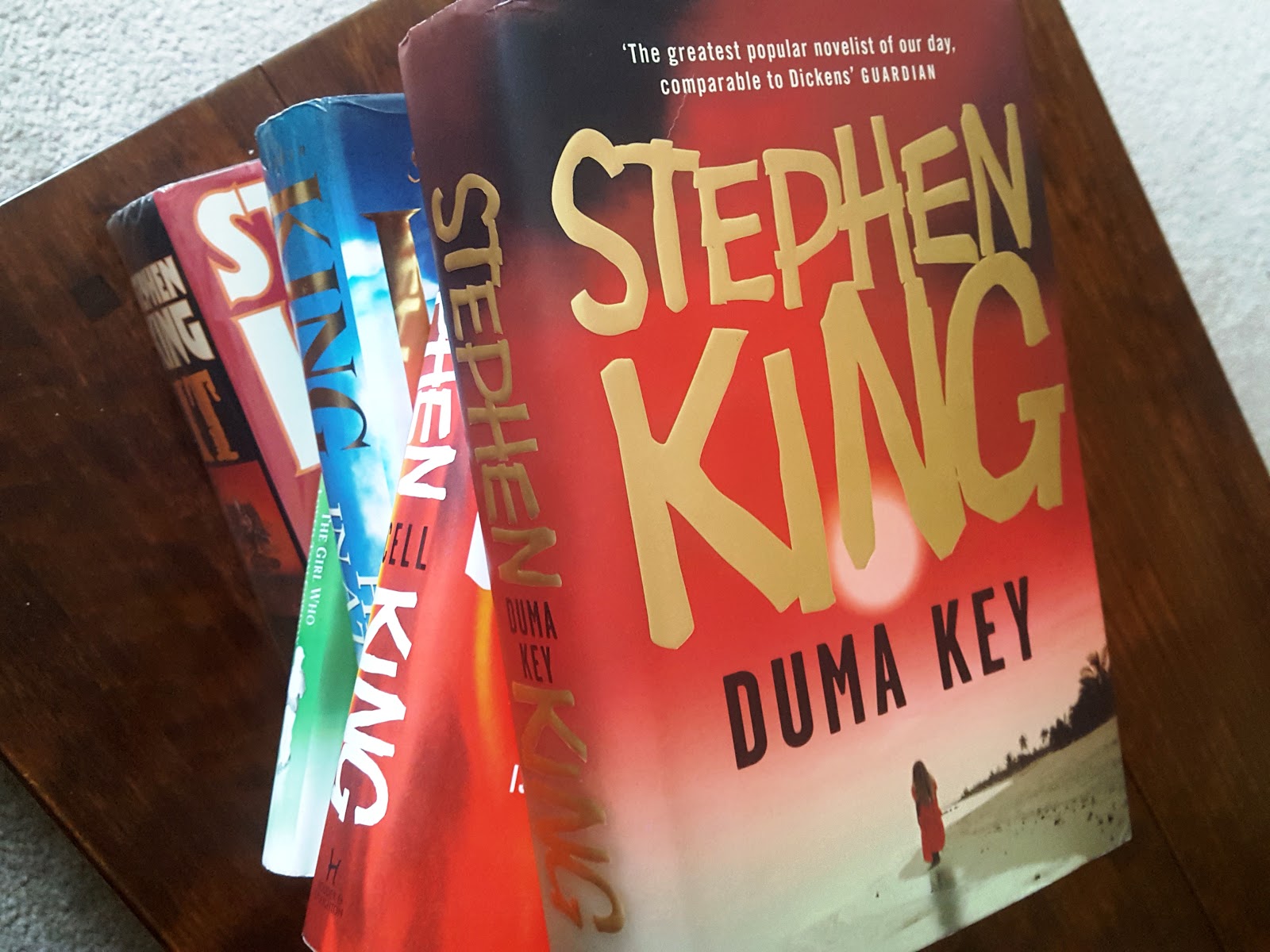
Eddie Freemantle, is an ex-construction
guy, who's lost an arm in an accident. He wakes up in a spiral of depression,
beats his wife, who then files for divorce, and has an itching limb that no
longer exists - something which I understand is true for some amputees.
So, on advice from friends and his doctor,
Eddie make for Florida and ends up renting Salmon Point, (Big Pink), a large
detached villa, with the most amazing views across the Gulf of Mexico.
To date, Eddie has no more than sketched a
few doodles, but suddenly, and with great gusto, he begins to draw; an activity
which brings him much relief.
He draws his daughter with the man she is
engaged to, (even though he's never met him), he draws his old accountant,
dead, calls his ex-wife and convinces her that he thinks the old boy is about
to commit suicide, and saves his life. He draws his ex-wife's new flower
tattoo, the one he's never seen, and he draws the face of a stranger, a man
who's kidnapped and murdered a young girl, but he draws him without a nose or
mouth, and the next day, said kidnapper has suffocated.
There's a lot of weird stuff going on in
Duma Key, nothing more strange than the, ‘Girl in a Boat’ series of paintings,
which have an uncanny resemblance to his youngest daughter, and seem to be
drawing her ever closer to an old sailing boat in the distance.
I love the build-up in this book: Eddie
gradually regaining his strength and purpose, the friendship that grows between
him and his neighbour, (a stranger by the name of Wireman), who of course has
secrets of his own, and Elizabeth, owner of Salmon Point.
Wireman is there to look after Elizabeth,
the daughter of the man who used to own the whole island, and whose sister
drowned, many, many years before. But there's a spirit on the island too, an
evil spirit; a spirit that gives Eddie the ability to paint exquisite
seascapes, to paint possible futures, but a spirit that could end up destroying
everyone he loves, taking the island and much more with it.
A bit like in, ‘IT’, this spirit has been
tackled before, but now, years, decades later, it is back and getting stronger,
so, Eddie, Jack (Eddie's personal assistant), and Wireman must face it together.
There are some really good bit in this
book: the early realisation that his drawings might be influencing real life,
his relationship with his daughter and ex-wife, the art exhibition he's talked
into putting on, and towards the end, the crocodile in the swimming pool
incident, but overall, repetition start to creep in and spoils it a bit.
Not quite a four star book then, three and a half, but spooky enough in places to satisfy those that like a fright, and descriptive enough to make me feel like I'd been to the Florida Keys and that my arm was itching!
Not quite a four star book then, three and a half, but spooky enough in places to satisfy those that like a fright, and descriptive enough to make me feel like I'd been to the Florida Keys and that my arm was itching!
Wednesday, 26 July 2017
Heart of Herts, book review. (Hertford Writers' Circle)

I have to admit, I read very little
non-fiction, but a couple of my favourites in this collection fell into that
category, which is what reading is all about I think: discovering something new.
From medieval Hertford, to time travelling
spaceships, fiction to non; from teen romance, through a Saxon invasion, to the
end of the world, this collection of short stories has the lot.
Where would we be, I wonder, without a
place to scatter loved ones ashes, Charlotte Holmes excavating bones and a
squeaky hospital door?
This volume contains works from eighteen
different writers, with styles so eclectic, that you'll never be lost for
something new. We have the plague, we have ghosts, we have historic and science
fiction, there is death, (obviously) but there is life too, and love, lots and
lots of love.
With such strong writing, vivid pictures
of ancient lands and ghostly schools are conjured with aplomb, and one’s
imagination runs wild; wild like the Meads that separate Hertford from Ware,
wild like the storms that surge across open fields, wild like the Pageant fever
that gripped Hertford in 1914.
To single out any particular author or
story for merit here, would be wrong for two reasons: one, because I enjoyed
them all in different ways - some were historic, factual, some were not, some
were humorous, whilst others were sad, and having made Hertford my home for the
last decade or so, I have had the honour of meeting some of these authors,
which brings me to the second reason for keeping my opinions to myself: I'm too
gutless to praise one of them over the others!
Oh, sod it, we're all adults here. This
is, Mad Mike’s Writing Blog after all. Since when have I shied away from an
opinion?
Ken Boyter: if you'd like to stand and
receive your prize. Your depiction of what must have been a very difficult time
in your life, honours those involved beautifully, and as I said at the
beginning, non-fiction isn't something I dabble in much, but now, thanks to
you, my eyes have been opened.
If anyone reading this post
would like a copy of this collection, please message me or, head to:
http://www.hertfordwriterscircle.org/anthologies.html, where you can contact
the Hertford Writers' Circle for a copy.
Enjoy.
Sunday, 9 July 2017
Let the Right One In, book review. (John Ajvide Lindqvist)

I wanted to like this book, I wanted to
love it because it looked intriguing, but it wasn't all plain sailing.
This book is about friendship, where one
can't exist, love where there is none, and fear, fear of the unknown.
It has the sort of atmosphere I've begun
to crave recently, fabulous characters, against a cold, distant, almost
characterless setting, which make Oskar and Eli stand out even more, like Technicolor
people against a monochromatic backdrop.
Oskar is bullied at school and this is
handled well, the swimming pool scene in particular deserves merit, and his anxiety
is believable and heartfelt. Eli, is both beautifully, weird and
frightening, in equal measure.
Hakan, Eli's father/guardian, is a bit
weak, he has lots of money but lives like a tramp, and I definitely think
he should have died when he fell from the hospital window. (I know this is
fiction, vampire fiction, but still, I thought it would have been more
realistic if he'd died from the fall).
I thought the sex with the young boy at
the beginning was too graphic. I understand that it sets up Hakan's character
and what he is capable of, but still, it was a little unnecessary.
Also, I have the first edition in English,
and I think a few things might have been lost in the translation.
At one point, Oskar is in his apartment,
(having stashed Eli's money in the basement), contemplating how the bullies at
school get him to squeal like a pig for their amusement, but then, the next
minute, he's at the school, setting fire to his tormentors desks. I thought
this was a dream at first, that he'd fallen asleep, because it seemed to jump,
but in hindsight, I think there was a page-break missing, and it's not the only
time this happened, which was somewhat frustrating.
All told, this book hits the spot in some
areas, and is well worth a read, particularly if you like to be chilled and
made to feel slightly uncomfortable, and on that basis alone I would have given
this book four stars, but there's one thing I just can't forgive: why, in spite
of the atmosphere, some truly excellent characters, the swimming pool scene and
more, did the author chose to reveal that Eli was a boy!!! Maybe he
thought it would be a cool twist? A curve ball? Whatever the reason, for me, it
let the book down.
Call me conventional, call me boring, but
I liked Eli as a girl. As soon as I found out her/his secret, I sort of stopped
caring, which is the last thing an author would want, but, there it is.
Three stars.
Subscribe to:
Posts (Atom)