Showing posts with label murder. Show all posts

Sunday, 20 February 2022

A Slow Fire Burning, book review. (Paula Hawkins)

Much like Paula Hawkins' second book, Into the Water, A Slow Fire Burning is a book full of characters. Some you like, some you don’t, some you feel sorry for and some you want to throttle but all the same, they all seemed well rounded to me, particularly Laura Kilbride – a girl who has nothing but a shit life and a limp - a limp we later find out was caused by the man who was having an affair with her mother when he knocked her off of her bike (she was thirteen), before fleeing the scene, only to become her step-father a few years later – and I particularly liked Irene, who is widowed, elderly, a good neighbour and has Laura buy her shopping for her.
Then there’s Daniel Sutherland, who has been stabbed to death on a narrowboat in the centre of London, and the setting alone, with its alleyways, bridges, toe-paths and splattering of expensive houses juxtaposed with Laura’s high-rise council flat, is like a character in its own right (there’s a map included, too, so don’t worry), and adds a lot to the story.
In addition we have the nosey neighbour, Miriam: 53, dumpy, unattractive (her words not mine), keeps herself to herself, but has a tendency to be very vigilant - which stems from the time she and a friend where kidnapped when they were fifteen and her friend was killed – who happens to see Laura one morning (the morning after the murder), leaving Daniel’s boat with blood on her cloths, as does a local author, Theo Myerson, whose house fronts the river.
Now, Theo was married to Carla but after the loss of their son, Ben, thirteen years earlier, they separated; it is Carla’s nephew who has been murdered.
Carla’s sister, Angela, who also lives by the river (next door to Irene in fact) and has spent the last thirteen years drinking to block out the tragedy of Ben falling to his death from her balcony when she was supposed to be looking after him as opposed to shagging some bloke, is also dead;
 but is falling down the stairs when you're an alcoholic suspicious or not?
The writing here is clever in revealing just enough about the double lives being led, the hatred and obsessions between characters and in some cases their history, that I found it hard to put down, and it has suspense, fear, sadness and kept me guessing until the big reveal at the end, which I loved.
Poor Laura (or is she?), is dragged in for questioning, twice, loses her job and has her flat searched, all whilst Miriam, who found the murder victim, is stealing evidence, tipping of the police and harassing Theo, who in turn, is in and out of his ex-wife's (Carla's) bed, in spite of their separation, and lies continuously.
Crime?
Thriller?
A ‘who done it’?
Maybe it’s all of those.
But who cares for labels when a book takes you through so much at such pace with characters you root for and those you don’t, in such a great setting in the heart of London? I don’t and I suggest neither should you because whether it's Laura, Theo, Carla, little old Irene (remember Miss Marple, who fools everyone time and again into thinking she's a frail old lady sticking her nose in where it isn’t wanted?), Angela, before she had her ‘fall’ or invisible Miriam on her nice tidy narrowboat, who is the murderer, you are going to love finding out.
Four stars for Paula Hawkins’ third novel then, with the only week link being the police officers – although Laura, when she is interviewed is brilliant, and had me totally invested.

Don't forget to search my blog for your favourite authors and books and if I haven't read them, message me with your recommendations.

Sunday, 6 February 2022

The Girl With the Dragon Tattoo, book review. (Stieg Larsson)

This is a reread for me, as per my blog post on the 1st January, so having read this several years ago and never moving on and completing the trilogy, I thought it better to refresh my tired old brain before books two and three, and I'm glad I did.
The book opens with Mikael Blomkvist having just lost his highly publicised libel case against the very wealthy and corrupt Wennestrom and what could be the end of his journalistic career and the magazine he co-owns with his part time lover, Erika Berger (Millennium). But there's hope on the horizon. The industrialist billionaire Vanger.
Vanger lost his niece, Cecilia forty year ago, disappearing off of the island (Hedeby), the family own and live on, never to be seen again, and her disappearance, which he strongly believes was murder - has become an obsession; but time is running out, Vanger hasn't long, he's old and, thinking that one of his own family is responsible he needs to try one more time to get to the truth.
Then there's Lisbeth Salander, the girl with the dragon tattoo; a computer hacker, sorry, 'investigative researcher' and before employing Blomkvist, Vanger has had her look into his background, which leads to her and Blomkvist working together later in the book.
With Blomkvist going through the archives on Hedeby island, speaking to family, piecing things together, Salander begins investigating further afield, all whilst dealing with her new legal guardian (her previous guardian having died), who rapes her repeatedly before she exacts a very explicit revenge, and it is here, in the thick of the book where the writing becomes exceptional.
Chapters fly by as clues are unearthed, twists follow turns, secrets are revealed, lives are threatened and lost and as the book bounces between characters, it unearths the darkest secrets of a family Nazi and his legacy and, when Blomkvist is captures and tortured - by the serial killer Vanger suspected was in his family all along - and when Salander taps Cecilia's sister's phone in England, the truth of what happened to Cecilia all those years ago is unearthed.
This is not a short book but it's a page turner, feeding you just enough to keep you guessing. I liked the characters, too - although there did seem to be a rather high proportion of weirdo's to non mentally challenged people in this book - and when it gets violent it gets seriously X rated violent, so it's definitely not a book for the faint hearted/easily offended - you have been warned.
Four and a half stars for the first book in the Millennium trilogy then and highly recommended to all who like books with grit, mystery, multiple characters and with a good dose of back-story.

Don't forget to search my blog for your favourite authors and books and if I haven't read them, message me your recommendations.

Sunday, 25 July 2021

Mrs de Winter, book review. (Susan Hill)

Having just reread Daphne du Maurier's Rebecca (see 27/6/21 post), loving it just as much
as I did the first time, and being thoroughly in awe of the author once again - My Cousin Rachel and Frenchman's Creek having cemented my love for her books even more - I thought I would reread this, Susan Hill's sequel, straight after.
With Susan Hill also in my top ten authors, I had high hopes, and coming off of the back of Rebecca, with all that went on at Manderley fresh in my mind, it was the right thing to do.
So, over a decade has passed since our unnamed narrator and her husband (and murderer) Max de Winter fled to Europe. The authorities do not pursue them, for the death of his first wife Rebecca was deemed an accident, but the memories of her death, the burning of Manderley, the bribery attempt by Rebecca's cousin, Jack Favell and the cold icy fear that Mrs Danvers installed in the first book, still do, so they stay away, far, far away, until . . .
They are summonsed back to England for a funeral.
Max's sister has died.
They arrive back in the nick of time, planning to stay only a shot while - only long enough to settle some affairs, put the estate in order et cetera, but Frank Crawley, Max's right-hand man from Manderley is there, and he is well and enjoying life in the highlands of Scotland, so they must visit him before they depart - take flight! - surely?
As with Rebecca, the tension in this book is subtle at first: our narrator being concerned for Max's health if they return, what people might say and think; that everyone will remember the outcome of the inquest into Rebecca's death but possibly have had their heads turned in their absence, but when those fears do not materialise and they find an idyllic but somewhat neglected Manor House in the Cotswolds, all seems well with the world.
Then, Jack Favell! Rebecca's cousin and lover.
The chance encounter with Favell in London brings to the fore our narrator's fears, and the lies she tells as to why she's there, along with the demands for money that begin to arrive a few weeks later, create more tension, and her and Max's relationship becomes tense, and then . . .
Mrs Danvers, and t
he De Winter's relationship hardens further, the garden party that Mrs de Winter was so looking forward too ceases to hold interest - painful memories of the Manderley ball come flooding back - trust is lost and secrets are revealed and . . . and . . .
Susan Hill's writing is as always, exemplary, but I did find some elements of the story a little drawn out, not quite as punchy as they could have been and I wondered whether a shorter book might have been better, but with passages like, 'It was not the the flowers at which I started, in horror, not the printed words that chilled me, splintered the sky and fractured the song of the blackbird, darkened the sun. It was the single handwritten letter, black and strong, tall and sloping. R,' you can see why I hold the author in such high esteem.
Three and a half stars for Mrs de Winter then. A thoroughly good read.

Don't forget, search my blog for your favourite authors and books and if I haven't read them message me with your recommendations.


Sunday, 27 June 2021

Rebecca, book review (Daphne du Maurier)

Opening with one of the most famous lines in the history of literature, Daphne du Maurier's Rebecca will be no stranger to many of you, as it wasn't for me, but with my memory for all things past being somewhat vague, and the passage of time since I first picked up this masterpiece being rather long, I thought it only right to add it to my 'year of the reread' list.
Beginning with a short dream - the one of Manderley - before being whisked off to Monte Carlo where our unnamed narrator is the bored and rather put-upon companion to a Mrs Van Hopper (a rich but rather crude woman, who quickly falls ill), she soon finds herself lunching, riding around in a motor car, and falling in love with the recently widowed Mr de Winter.
There is a distinct difference in their ages, upbringing (read: breeding) and social standing, but a connection has been formed, and so, when Mrs Van Hopper discovers that she has to leave post-haste for New York, a decision has to be made and Mr de Winter proposes.
They honeymoon for several weeks before returning home but with the bride having no family to return home to, they head for Cornwall, to Manderley.
There are four main characters in this novel: Rebecca, Mr de Winter, our narrator and Manderley - sorry Mrs Danvers - with its imposing mile long drive, its vast grounds, mazes of passageways and unseen doors, and of course, let us not forget, The West Wing - where Rebecca used to reside before her unfortunate accident at sea. However, where the house oozes a charm and warmth but with a sense of foreboding, Mrs Danvers dispenses with the former as she robotically runs the house, and she is very much the 'other woman', sometimes spooking the new Mrs de Winter by turning up when least expected, and her presence, her constant niggling, her suggestion on what dress her new mistress might wear to the upcoming fancy dress ball, the fact that she keeps the West Wing as a homage to Rebecca - her old possessions, even down to her hair brushes, remain as they were the night she died - all adds to the sense that Rebecca has never left; that she's still there, alive in the walls, the furnishings, in the flowers that grow outside or are cut and placed in vases around the house.
There's also Frank Crawley, the estate manager, Bee and Giles, Maxim de Winter's sister and brother-in-law and Jack Favell, Rebecca's cousin and all round bad egg, but the really clever thing about this book is how the characters with no real voice - Rebecca is dead remember and a house can't talk - monopolise the narrative. Of course, Mrs Danvers plays a key roll in unsettling the new Mrs de Winter by reminding her how beautiful Rebecca was, how organised and successful her running of the house was, how much everyone loved her, flocked to her, held her in the highest esteem, which speeds you through the book in no time.
Du Maurier writes with such skill and passion throughout this book that even when we encounter the mundane, those elements of daily life like: walking the dog, eating breakfast, reading the paper, you are still enveloped in the scene, to the extent that you can almost hear the ticking of the carriage-clock, the creek of a floorboard, the rustle of a folding newspaper, and it is this skill, along with her amazing ability to create tension out of nothing, like the change in the weather, a thunderstorm with no rain, Maxim de Winter confessing his crime two thirds of the way through but leaving Rebecca's secret, the fate of Maxim and Manderley to the end, that elevates the author and this novel to one of the best I have read.
Five stars then for Rebecca and a commitment to continue working my way through the author's extensive back catalogue.
Don't forget, search my blog for your favourite authors and books and if I haven't read them yet, message me with your recommendations

Saturday, 31 October 2020

The Taxidermist's Daughter, book review. (Kate Mosse)

Atmosphere.
If you like a book with atmosphere, whether you're on the moors with Cathy and Heathcliff, crossing the causeway to Eel Marsh House, running from the ruins of Manderley, or walking the rain soaked alleyways of Carlos Ruiz Zafon's Barcelona, if you like your books with atmosphere look no further than Kate Mosse's, The Taxidermist's Daughter.
A hundred years ago in the small fishing village of Fishbourne on the south coast of England, there was a terrible storm, a storm that caused the tide to surge and breach the sea defences, a storm that brought death and destruction but also a cleansing, because before that storm there was rot in Fishbourne, unholy activity, secrets that Connie Gifford has long forgotten, and a killing of a different almost animalistic kind, a kind that exposed the depravity of man . . . before the storm.
Having finished the author's Langudock series last year I felt a little deflated (I loved Labyrinth and Sepulchre but really didn't get on with book three, Citadel) so I'd left this one on the shelf collecting dust, which was one hell of a mistake.
From page one, and I'm not embellishing here, from page one I was hooked, and who wouldn't be when it starts with a rain-soaked funeral attended by strangers with a certain familiarity and the murder of a young woman?
For Connie Gifford her past is a blank, her first ten years are missing. She lost her memory when she had a fall, or was it a shock, or was she . . . But why can't she remember? Did she really just trip and fall down the stairs, hit her head like her father told her, or was there more to it than that?
A few days after the funeral a young woman's body is found in a stream by Connie's house and Connie thinks she recognises her, but does she? Could it just be that the coat is familiar? The coat she saw someone wearing at the funeral, and so begins the unravelling of the mystery.
There's the strange disappearance of her alcoholic father - no-one seems to know where he is - the arrival of a stranger, Harry Woolston, who professes to be the son of the local doctor, but is he and can he be trusted? And where is his father? Why did he leave for the specialist hospital so quickly and not come back?
There's the ever present threat of the storm as it builds momentum through the book, the inquisitive local bobby (policeman) making his enquires and casting his aspersions, the sudden occupation of Themis Cottage by an unknown single woman (this is 1912 remember) and the continuous and horrific slaughter of the town's menfolk, all as the storm makes land, the tide rises and the solitary blinking light from that cottage pulls Connie, Harry, the policeman and many more besides likes moths in the dark, and makes for one hell of a climax.
You'll have to read the book to find out what happens of course but believe me, it is very well worth your time.
Chilling, spooky, rain soaked town on the south coast of England in the midst of a murder spree in the early 1900's with beautifully written characters, great plot, plenty of blood and intrigue; what's not to like?
Four and a half stars and one of my favourites so far this year, and with winter approaching, what better time to immerse yourselves in the pages of a book like this.

Don't forget to search my blog for your favourite authors and books to see if I have read them yet and if I have not, why not message me with your recommendations.

Thursday, 27 February 2020

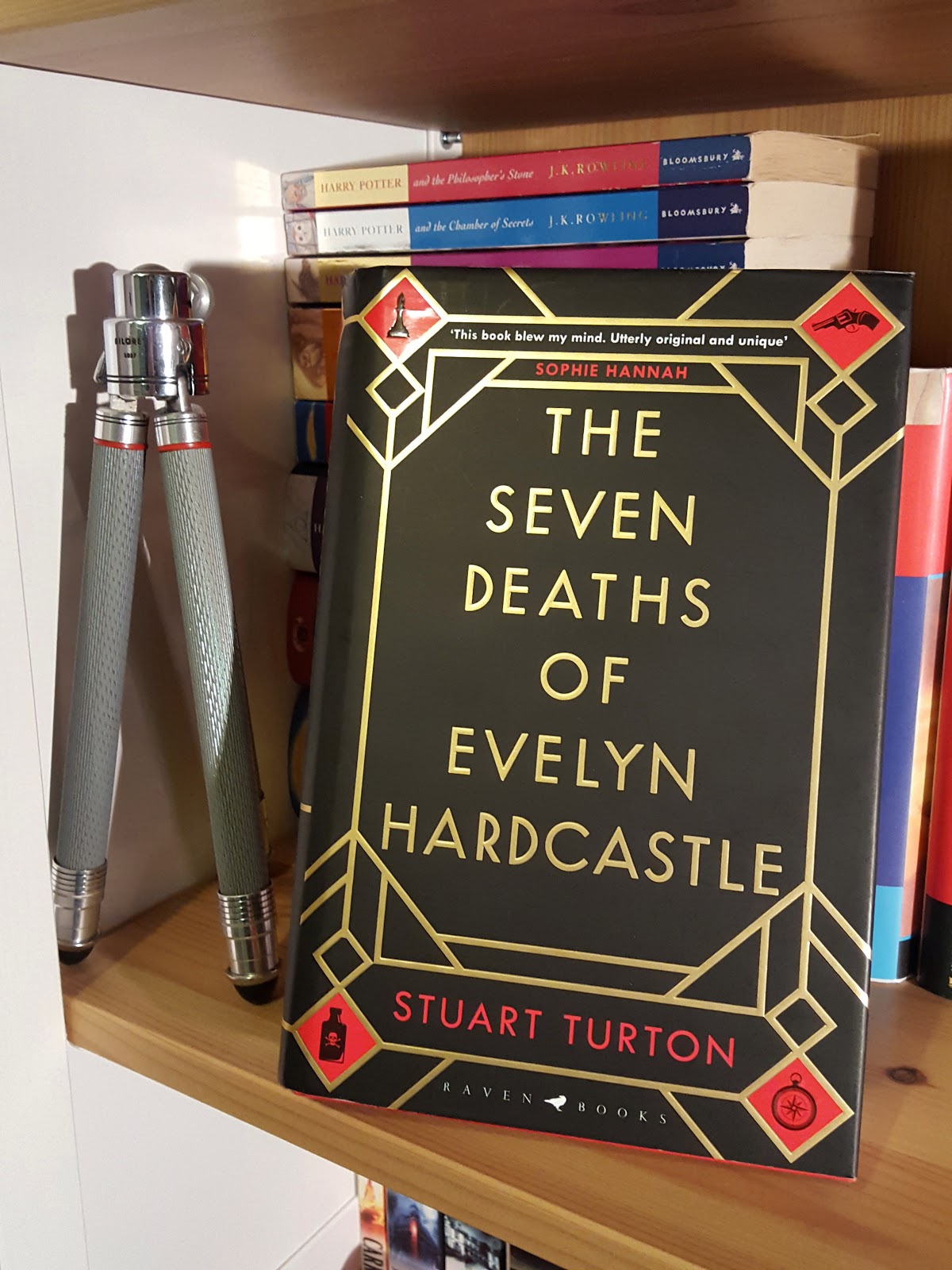
The Seven Deaths of Evelyn Hardcastle, book review. (Stuart Turton)

Oh No!
Have I found my book of the year 2020 already?
Well . . . Maybe!
Confusing, fast-paced, witty, horrific intriguing and I'll-be-damned-if-I'm-putting-this-book-down-it's-only-half-past-one-in-the-morning-and-I-really-really-really-need-to-know-who-the-murderer-is, oh, shit it’s . . .!
If you like murder mystery, crime, romance, character lead drama, family sagas, a good old punch up, some serious skulduggery and subterfuge, then you are simply going to love this book.
Set in the eloquent but scratch-beneath-the-surface-and-you'll-see-the-peeling-paint-mansion that is home to the Hardcastle family and has been for generations, we find our main protagonist (Aiden Bishop) trapped in the body of a man he does not recognise, a man who feels utterly alien to him in both body and mind, and it all kicks off like a slap in the face.
Aiden Bishop will have eight hosts throughout the book, each reliving the day of Evelyn Hardcastle's death (which at first appears to be a suicide) from different perspectives and it reads like Agatha Christie does Cluedo.
Aiden Bishop is assisted by Anna, whose name is the only thing he remembers when he first wakes as the cowardly drug peddling Sebastian Bell, deep in the woods, but as the days pass he morphs into a butler, a morbidly obese Lord, a rapist and a cad, an aging solicitor, a gambler, all before becomes a policeman and finally, an artist, who help, but in some cases hinder, in his search for the truth, and it'll be all for nothing if he can't solve the murder before the end of the eighth day, for that's when the cycle will reset, his memory will be wiped and everything will start afresh, taking him back to the very beginning, where it will continue to loop, for however long it takes him to not only find out who the perpetrator of Evelyn's murder is, but the reason why they want her dead in the first place.
I love the way this book is written, how Aiden battles inside each of his hosts: disgusted by the Lord's obesity, the solicitor's contempt, the gambler's cunning, the rapist's despicable mind and more.
With each character helping to reveal more about what may or may not have happened and the delicate intricacies between them as they try to gain favour and information - some becoming incapacitated and popping up randomly through the book, others making their bid for freedom - Aiden is gradually left with fewer and fewer friends and even fewer option. So should he trust the not so trustworthy Anna? The man in the death mask? Should he trust anything he's learnt over the last eight days? And where the hell is their host, Evelyn's mother, Mrs Hardcastle, who no one's seen all day?
Simply put, this book is brilliant. It’s original, has superb characters and just keeps going until the very end. Highly recommended.
Four and a half stars then and don't be surprised if you see this book making an appearance in December when I decide on my book of the year.

Tuesday, 14 January 2020

The Nutshell, book review. (Ian McEwan)

If you think a story told in the first person by an as yet unborn foetus, silly, ridiculous or just plain weird, I am not going to try and change your opinion, but I will encourage you to read it all the same.
Told over the course of a few days, with some flashbacks thrown in for good measure and told from the confines of his mother’s belly, it is her son-to-be that hears about his father’s intended murder, her collusion with his uncle to sell their house and start afresh, and he hears his dad too, when he pops in and pledges his love for his wife, sharing his hopes and dreams for the future - returning to the marital home that was his grandfather’s and father’s before him being just one of them (the house is worth several million pounds and is very much part of the uncle’s plan when it comes to murdering the brother) – but our storyteller also notices the lack of discussion about him, about baby, and although not born yet, it’s a worry!
When his uncle does finally mentions him, whilst getting drunk with his mum - the alcohol being most welcome - the conversation doesn’t sound so good. They talk about selling the house and passing him on, separating him from his mother, a mother he loves at times, particularly when the food and drink are good, and loathes at others, when she talks about killing his father and abandoning him.
Like many of McEwan's books, (I’ve yet to read them all) the writing here is pure prose, but I think this one would have worked better if the writing had been toned down a bit, to fit with the narrator’s unusual situation.
What I did like was the baby’s interaction with mum when she ate and drank. His thoughts behind trying to prevent his father’s demise, how he intended to stop his mum and uncle doing a runner before the police turned up, his failures and his successes.
When mum eats well, he feels it, when she drinks too much, he feels that too and when he hears his mum and dad argue, his uncle plotting, he decides there has to be a way he can intervene, but tying his cord up doesn’t work, his fingernails are too soft to tear that membrane and not only is time running out but space is too.
Three and a half stars for this one methinks as it was a good attempt at something I haven’t heard being done before and has the usual McEwan beauty to the writing - if you like that sort of thing.

Saturday, 30 November 2019

Herts & Minds anthology is launching on Wednesday 11th December 2019

If you like ghosts, ghouls, and Werewolves, the beauty of the English/Hertfordshire countryside, a wandering cat cast in bronze, that comes alive by night, historical fiction, death by dangerous driving, poetry, or a good old fashioned crime drama, then you're going to love the Hertford Writers' Circle 2019 anthology, Herts & Minds.
From our home town of Hertford to New York, from the slave trade to murder, from Welwyn to the remotest corner of Ireland, this book will take you there and further.
Packed with dramatic stories about snakes, flowers, aliens, bullying, a dystopian Hertford, and finding a corpse in the boot of your car, we've got it all, and you could too if you are in Hertford on the night of the 11th December (Wednesday) and would like to join us at the books official launch (7:30 pm, Courtyard Arts, Port Vale, Hertford, SG14 3AA) but if you are not, if you hail from further afield but would like to purchase a copy - for yourself, a friend or for Christmas - just message me in the comments or via my Amazon author account and I'll make sure a copy wings its way over to you as soon as possible.
For an exclusive extract from this anthology, visit my blog again on Christmas Eve, for I will be posting, The Sprout that Ruined Christmas, which I may also read at the launch if I feel brave enough.
Enjoy.


Monday, 25 April 2016

The lovely Bones, book review. (Alice Sebold)

Wow. A book about murder, death, abandonment loss and depression, that leaves you feeling happy, joyous and longing for more. Wow indeed. 
This book got some good reviews when it first came out and was of course made into a film (which I saw a few years ago), but like most of the books I read, I read them when I feel ready, not when the hype or the movie release dictates. 
Told in the first person by a murdered fourteen year old girl, (Susie) the book takes you from the high of a teenager's first kiss, to the low of her death. Raped and killed by a neighbour, in a hole he'd dug in a corn field, (and then dumped in a sink-hole), Susie's body is never found; so her family never really find out what happened to her.
Once dead, Susie is unable to rest in her heaven, so she visits her family and friends as often as she can; her brother repeatedly comments on how he can still see his sister, but as a reader, we're never really one hundred percent sure if he can or not. This, I think, adds a nice element of uncertainty to the book. 
We witness her father's slide from successful businessman and loving husband, to a broken man who's lost his daughter, his wife and his mobility, (he suffers from a heart attack later in the book), all whilst Susie's brother and sister grow up, with their mother in California. 
There is great drama when Susie's sister goes in search of clues in the killer's (neighbour's) house, and then there's chapter 16, where the family, her school friends and the local community, go to the field where she died, in recognition of the anniversary of her death. This is one of the best chapters I have ever had the pleasure of reading, in any book, ever. It is so moving, so perfectly timed within the story and just has you reeling for more. 
Powerful stuff them? You bet, and Alice Sebold keeps it coming until the very end, but I won't reveal any more here, I’ll just finish by saying whatever you do, READ THIS BOOK. 


Thursday, 5 November 2015

The Almost Moon, book review. (Alice Sebold)

Having purchased Alice Sebold's 'The Lovely Bones' for a work colleague and it receiving high praise, I decided to purchase 'The Almost Moon' when it cropped up in my local charity shop. 
The book is set over a single, twenty four hour period, and starts with Helen Knightly tending her mother. The tension between them is tangible and within a few chapters, Helen Knightly is a murderer. 
Sebold handles what is a very personal crime, with great skill. During the book, Helen seems to go from slightly deranged, she has sex with her best friends son (he's an adult), to being childlike, she confides in her ex husband that she's killed her mother, and everything in between, like going to work, which happens to be life modelling.
This is a short book, and an odd one too. The subject of matricide is one that I hadn't come across before, but an interesting one all the same; and as you read further, a history of agoraphobia and other mental illness's in the family are revealed. So, reasons for Helen's instability become apparent, and the author could easily have tried to justify the murder this way, but she doesn't, she just uses the past to explaining why Helen might have murdered her mother. 
So, a good little book then. Three and a half stars, but not four, so I'll settle on three.
Now all I have to do is borrow 'The Lovely Bones', which I saw on film but haven't read yet.