Showing posts with label instabooks. Show all posts

Sunday, 30 September 2018

The Trial, book review. (Franz Kafka)

Errr! Lost in translation, or, maybe not!
Okay then, Kafka's, The Trial, was exactly that to read, a trial; of my patience, my sanity and my time.
If this was dystopian or Sci-Fi, it might make more sense, but as far as I could tell, the book was set at the time it was written and in Europe, not some skewed alternate universe, which was how the book read.
Josef K is arrested at his home but not told by the guards why. Nor is he told by their supervisor or anybody else for that matter, so he goes through the entire book not knowing who has accused him of what and with no idea of how to defend himself.
He meets random people in lofts (court chambers that double as people’s bedrooms), an advocate who's been working on another man's case for five years with no resolution, a priest who seems to know him and his case, but not enough to actually tell him anything useful, and several women who are all attractive, and become instantly attracted to him!!!
On top of this, you get paragraphs that extend to over a page where two or more people are talking about multiple topics, and I had to wonder, if anyone else wrote something as disjointed as this book, whether they would they ever get it published? (That’s a No by the way).
I know that some of you might take umbrage at my views, that some of you are far more intelligent than me, (or smoked the right drugs), and will say that I just didn’t get it, but I would question, what is there to get? To me the whole thing was just one big confusion, where no-one seemed to know what the hell was going on, and another thing, everyone seemed to be poor, even Josef K, a successful banker, lived in a small rented room in a tenement building, as did the advocate, which again, made me wonder whether this book should be dystopian.
Anyway, in conclusion: don’t bother with Kafka’s, The Trial, read something else.

Saturday, 7 April 2018

Into the Water, book review. (Paula Hawkins)

I don't suppose I can review this book without mention, The Girl on the Train, Paula Hawkins' first novel, so I'll get that off my chest first. This book is better. There I've said it, and it's not that I didn't like, The Girl on the Train, I thought it was quite good, it's just that I liked this one more.
Another book worth mentioning is, J. K. Rowling's, The Casual Vacancy, my book of the year back in 2015, and the reason I mention it: because of the familiarity I felt for that book when reading this one. Let me explain.
Both books are set in small town/village communities in the English countryside, there's death, lies and intrigue wherever you turn, but the main difference I suppose, is that, Into the Water, deals with suicide and/or possible murder, as opposed to a heart attack. Both books though, are full of excellent, believable characters, tragedy and regret.
With, Into the Water, Hawkins has her characters narrate their perspective on things individually, which makes for a little confusion at the beginning, but you soon work out who is who and start joining the dots about how they're all connected.
I found the setting, the characters and their emotions quite believable, and as the reader learns, not only how the various men, women and children's lives are intertwined, but about their feelings towards each other, their pasts' and the history of the river at the centre of the story, one finds the pages turning that little bit quicker.
This is not a long book and there is no big reveal at the end, no, oh-my-god-it-was-them! moment, but I didn't feel let down because of it, I rather liked how the pieces started to come together and move toward a coherent and believable ending.
That's not to say this book lacks intrigue, if doesn't, there are a good few twist and turns on the way, and where somethings are explained, (the dead woman and her estranged sister's relationship), some are left to our imagination, (the whereabouts of an ex-teacher at the local school).
So, well worth a read then, and whether you liked, The Girl on the Train, or not, it really doesn't matter, because this book is totally different, and as I said at the beginning, in my opinion better.
Four Stars.

Thursday, 1 February 2018

The Road, book review. (Cormac McCarthy)

Okay, so this is an interesting book, it's interesting because it breaks the rule; it's also frustrating for that very same reason.
The book is about a man and a young boy making their way south, along, The Road. There isn't much to see and very little to do, other than hide from any would-be criminals and scavenge for food and water.
The book paints a very bleak future of a world that has been ravaged by . . .? Well, we don't know, it's just ravaged, and our two main characters, er! lets just call them, the man and the boy, because that's what they're called in the book, have their entire life in a shopping cart.
As they move ever closer to the sea, they have to hide, fight, run, lose all their possessions, get them back again and more.
The sense of isolation here, of hopelessness, is akin to John Wyndham's, The Day of the Triffids, and really punches through. The suspense: when they see or hear other humans, enter what they hope are unoccupied buildings, descend into cellars, where the man finds fresh clean drinking water, all have you biting your nails in anticipation, but, and this is where I feel the book lets itself down, it's all a bit too bland.
The world is grey, covered in ash, the sun never penetrates and the nights are cold, very cold, (it's because of the cold that the man and boy are heading south), but it's bland to the point of annoyance.
Back to my opening statement: this book breaks too many rules, well, it does in my opinion.
Books are supposed to have a beginning middle and an end, this one only has an end; the whole thing feels like the last few hundred pages of a much longer manuscript.
Not naming the characters, okay, fine, but without that, they lose some of their humanity, their identity, and you sort of stop routing for them, and my biggest gripe? No speech marks! Why? Why, why, why, do authors and/or publishers think this is okay? It's not clever, it's just bloody annoying.
So, in summary, it's a book about a world we don't know, with people we don't know, or get to know, travelling south to a place we don't know, with no speech marks.
For the sense of isolation and the tension created when the man goes into the cellar and confronts a would be attacker, and the fact that it is short and doesn't take long to read, I’ll give this one three stars.

Thursday, 30 November 2017

The Passage, book review. (Justin Cronin)

With the release of book three, The City of Mirrors, I figured it was time to go back to the beginning of the story and remind myself what I'd forgotten.
It begins in the world we all recognise. There are cars and shops and people going about their daily business, there's Amy, a girl of six, who spends her nights sleeping in motel bathtubs whilst her mother earns what she can; there's Carter, a death-row prisoner, and there's agent Wolgast, FBI, who's been collecting death-row prisoners for experimentation, Carter being his twelfth.
The beginning of this book is excellent. I like the contrast between the calm peaceful life of the nuns who look after Amy, against the pain, death and horror of The Twelve, incarcerated deep underground. I like the back story of the tourists in the jungle, the spookiness of the day Amy goes to the Zoo, how Wolgast's actions turn him into a criminal. I love the pandemonium when The Twelve escape and infect the world, and the isolation that follows Wolgast and Amy as they flee to the mountains.
Then, nearly a hundred years later, a small colony, humans living behind high walls, but the batteries that keep the lights on, the lights that keep the virals (blood thirsty vampire like creatures) away, are failing. They have a year, two at most. Something has to be done.
When some of the inhabitants go mad and let the virals in, a small group make a run for it; grabbing what weapons they can. They hole up in a fortified garage, find an underground bunker chock full of weapons, get rescued from an ambush in Las Vegas (which is a superb scene) and get taken to an ex-prison colony (The Haven) which is super strange because there are no virals there!
The human sacrifices that keep Babcock (one of The Twelve) and his hordes away, is soon revealed, and is followed by an epic chase across mile upon mile of open countryside on a fortified train, and it's the juxtaposition between heart in the mouth all hell is breaking lose, shit we've just lost another main character and the peaceful backdrop of snow covers mountains, where Theo and Maus have their baby and Peter and Amy find Sister Lacey with eleven vials of anti-virus, that makes this book so riveting.
There is so much going on here, that you might think you'd get lost, but with such diverse characters and such superb writing, you don’t, it just all makes sense. Coupled with a convincing setting, both in the present, past and possible future (the University of New South Wales are still reading from Sara's diary in the year 1003 AV [after virus]) I'm betting you’ll jump straight into book two, The Twelve, as soon as you’ve turned the last page.
An easy and highly recommended five star read.

Thursday, 28 September 2017

A Journey to the Centre of the Earth, book review. (Jules Verne)

Well what a jolly jaunt this book is; with polite peril and gentlemanly resolve, even in the darkest depth of the earth, it certainly is a throwback to the olden days. This is not a complaint by the way, but a compliment, and the language and general sense of the past, all add to the narrative.
After the discovery and subsequent solving of a three hundred year old puzzle, suggesting that travelling to the centre of the earth and how it might be accomplished, is possible, Axel, and his uncle, Otto Lidenbrock, (a scientist held in the highest regard), begin their journey.
Heading across Europe from Hamburg to Iceland, they make their preparations - hiring an Icelandic man by the name of Hans, and acquiring the necessary provisions for their decent into the volcano of Snæfellsjökull.
As you can imagine, their journey is fraught with danger: exposure, hunger, ancient extinct creatures, to name just a few, but when Axel becomes separated and believes all is lost, as his light gradually dims and he finds himself alone in the impenetrable dark, miles beneath the earth’s surface, you get a real sense of foreboding.
When our intrepid explorers discover an underground sea, with sandy beaches, cliffs, inlets and tropical foliage to boot, there is euphoria, but before all of that there is the thirst. Minutes turn to hours that become days, with no water, but what is that noise? Are they hearing things? Are they hallucinating?
With the last of his energy, and with brute force, Hans manages to bore a hole through the rock, and find water; hot scalding water, but water all the same.
Incidences like this befall our trio throughout the book, the tempest that destroys their raft and the battle between two giant marine creatures, are both worthy of mention, as is the constant sense of threat, but the stand out moments for me where, Axel's despair in isolation, and the almost catastrophic effects of their dynamiting what they were hoping was their path to the centre of the Earth.
It's not a long book this one, and is quite fast paced, especially the second half, so well worth a read.
Three and a half stars.

Tuesday, 29 August 2017

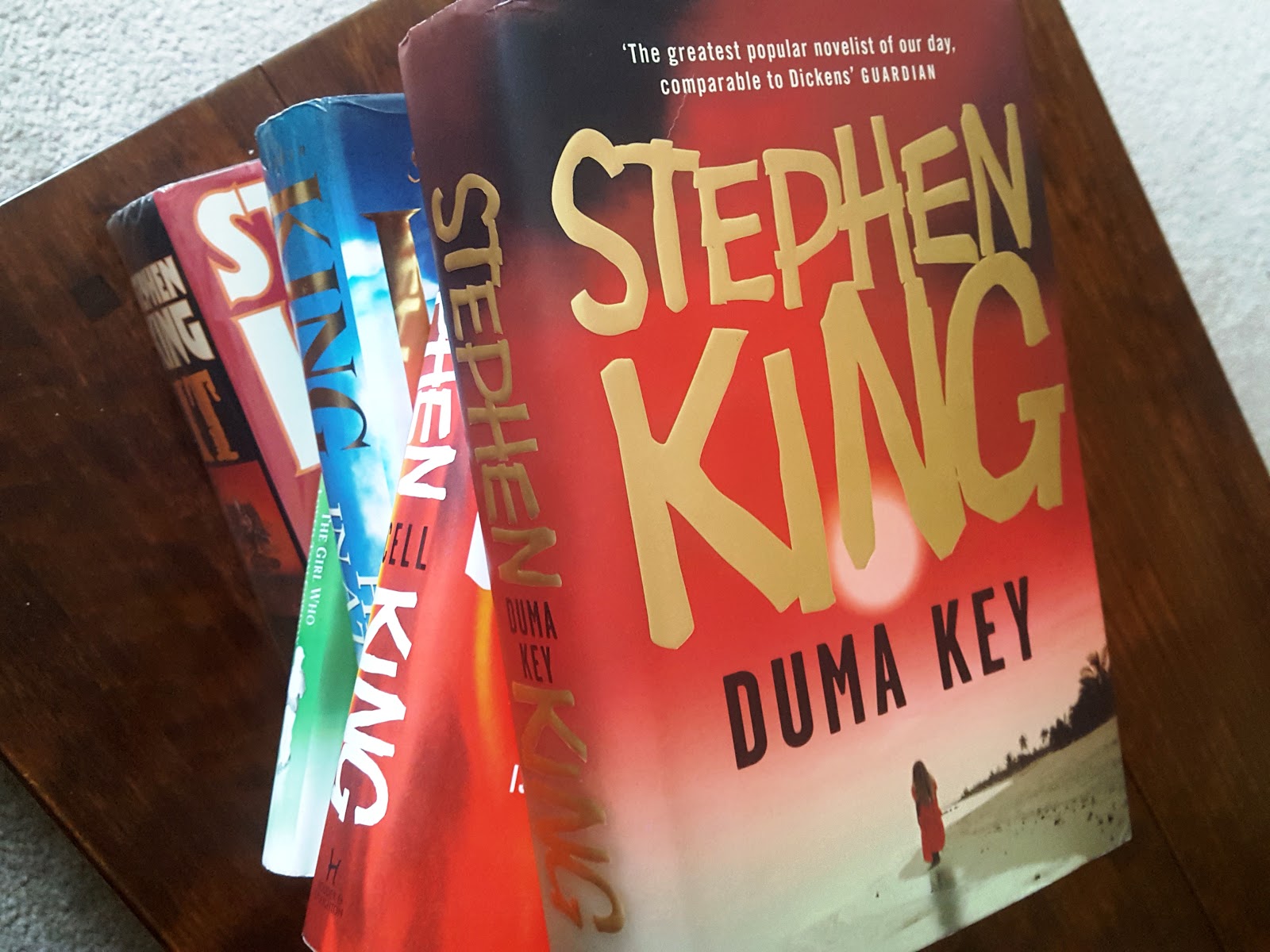
Duma Key, book review. (Stephen King)

Unlike Cell, which felt like a shortened version of a long story, Duma Key, felt like a longer version of a short story, something which is borne out by comments I have read on the internet.
Eddie Freemantle, is an ex-construction guy, who's lost an arm in an accident. He wakes up in a spiral of depression, beats his wife, who then files for divorce, and has an itching limb that no longer exists - something which I understand is true for some amputees.
So, on advice from friends and his doctor, Eddie make for Florida and ends up renting Salmon Point, (Big Pink), a large detached villa, with the most amazing views across the Gulf of Mexico.
To date, Eddie has no more than sketched a few doodles, but suddenly, and with great gusto, he begins to draw; an activity which brings him much relief.
He draws his daughter with the man she is engaged to, (even though he's never met him), he draws his old accountant, dead, calls his ex-wife and convinces her that he thinks the old boy is about to commit suicide, and saves his life. He draws his ex-wife's new flower tattoo, the one he's never seen, and he draws the face of a stranger, a man who's kidnapped and murdered a young girl, but he draws him without a nose or mouth, and the next day, said kidnapper has suffocated.
There's a lot of weird stuff going on in Duma Key, nothing more strange than the, ‘Girl in a Boat’ series of paintings, which have an uncanny resemblance to his youngest daughter, and seem to be drawing her ever closer to an old sailing boat in the distance.
I love the build-up in this book: Eddie gradually regaining his strength and purpose, the friendship that grows between him and his neighbour, (a stranger by the name of Wireman), who of course has secrets of his own, and Elizabeth, owner of Salmon Point.
Wireman is there to look after Elizabeth, the daughter of the man who used to own the whole island, and whose sister drowned, many, many years before. But there's a spirit on the island too, an evil spirit; a spirit that gives Eddie the ability to paint exquisite seascapes, to paint possible futures, but a spirit that could end up destroying everyone he loves, taking the island and much more with it.
A bit like in, ‘IT’, this spirit has been tackled before, but now, years, decades later, it is back and getting stronger, so, Eddie, Jack (Eddie's personal assistant), and Wireman must face it together.
There are some really good bit in this book: the early realisation that his drawings might be influencing real life, his relationship with his daughter and ex-wife, the art exhibition he's talked into putting on, and towards the end, the crocodile in the swimming pool incident, but overall, repetition start to creep in and spoils it a bit.
Not quite a four star book then, three and a half, but spooky enough in places to satisfy those that like a fright, and descriptive enough to make me feel like I'd been to the Florida Keys and that my arm was itching!

Friday, 18 August 2017

Harry Potter and the Deathly Hallows, book review. (J. K. Rowling)

I suppose, ten years after this book was first released, everyone knows everything there is to know about it, so if you've seen the films and read the reviews, there's not much point in my continuing . . .
WRONG!!!
These book have so much more depth than the films (although the last two films did portray this one extremely well) and there's no substitute for sitting down with your beverage of choice and sampling one of the greatest books you will ever read, is there?
Of course, getting there might put some people off, this is after all the seventh book, and not forgetting the seven hundred and sixty seven page leviathan that is book five, but I'd encourage anyone who asked to just go for it - because without reading the other books, you'll never have the pleasure of this one, Harry Potter and the Deathly Hallows.
Harry, Ron and Hermione aren't returning to Hogwarts to finish their seventh year, instead they have Horcruxes to find, pieces of Voldemort’s soul infused in magical objects, and once found, they'll have to destroy them. With the Minister of Magic overthrown, the Order of the Phoenix in taters, Severus Snape as headmaster at Hogwarts, Dumbledore dead, Harry's face plastered all over the magical world as Undesirable No 1, our intrepid trio have their work cut out, but with growing skill and confidence, a little help from a house Elf, they steal a Horcrux from Dolores Umbridge, escape the ministry - albeit not unscathed - find the sword of Gryffindor, escape Voldemort in Godric’s Hollow - Harry's birthplace – rob Gringotts bank, escaping on a Dragon, enter Hogwarts, virtually undetected, (freeing it of Snape's tyrannical rule), and all before the battle for Hogwarts has even begun.
My Harry Potter Collection, so far! I know, I'm mad aren't I?

Despite knowing what's around the corner, this book still had me on the edge of my seat, because you forget don't you? The little intricacies, the little differences to the films, and however good a film is, re-reading this thrilling book again, underlines just what a stunning story the author has created.

Concluding such a series can't be an easy thing for any author, let alone one who became so famous before she was even halfway through the overall story, but this book is handled with both care, passion and the seriousness that death, destruction, murder, and a battle to rival even that of Tolkien's, Battle of Pelennor Fields, needs, and with such skill, that it makes me want to go right back to the beginning, for what won't be the last time I'm sure, and start them all over again.
For twenty years we've been enjoying the ups and downs, twist and turns of Harry and his friends, and I see no reason why I won’t still be re-reading these truly astonishing books in another twenty.
Need I say it? FIVE BIG FAT GIANT GOLD STARS.

Tuesday, 13 June 2017

My Cousin Rachel, book review. (Daphne du Maurier)

I purchased this book from the charity shop (nothing out of the ordinary there then) about five years ago, and there it languished, on the 'to-read' shelf in the wardrobe: constantly overlooked, constantly put aside for something else, something more modern, more exciting, faster paced, more edgy.
That's sixty months, sixty! Or to put it another way, one thousand, eight hundred and twenty-six days I wasted, before reading My Cousin Rachel.
What an idiot, what a fool.
If only someone had told me. If only someone had written a review or a blog post, explaining how stupid I was being, telling me how I should have read this the day I bought it - hell, telling me I should have gone and bought it sooner, read it years earlier; well, now there is.
I implore you all, fellow book bloggers, bibliophiles, bookaholics, all those lovely people around the world that might read this post, all those that might have done as I have, and left this book to gather dust, read it now.
Du Maurier's incredible writing comes to the fore here, such believable characters, such eloquent prose, such beauty in her portrayal of Cornwall, (where the book is mainly set), and such suspense.
When Ambrose goes to Florence for the winter, to enjoy the warmer climes of Italy, his cousin and ward, Philip, thinks nothing of it, but when he marries and his letters become increasingly erratic, Philip starts to worry, so much so that he heads over to Italy himself.
On his arrival, he finds that Ambrose, who had looked after him since he was a small child, has died, and his wife, the mysterious cousin Rachel, has vanished.
Shortly after Philip's return to England, Rachel appears, but his anger, the betrayal he felt, evaporates. He is under her spell, captivated by her, but all is not plain sailing. One minute, there's delightful frivolity between Rachel and Philip, the next, it turns on a sixpence and one is shrouded in doubt.
Is Rachel all she is supposing to be? A grieving widow? Penniless? Did her first husband really die in a duel? Who is the mysterious Signor Rainaldi, friend or foe? And what of the hidden letters from Ambrose, talking of deceit, poison?
Du Maurier weaves such a web of doubt and intrigue here, that you just can't help but continue to read. You stay up late, you get up early, you skip lunch, avoid going out, and you put aside the chores, until you've reached the fabulous climax.
With the film released on June 9th (in England at least), I implore you to read this before seeing the screen adaptation, you will not be disappointed.
Five great big giant gold stars for this book then, and the best book I've read so far this year.

Friday, 9 September 2016

Harry Potter and the Order of the Phoenix, book review. (J.K. Rowling)

This might lose me a few followers or anger a few Potter fans, but I'm going to say it anyway, this book is just too long. 
There are moments of pure genius, the whole Ministry of Magic escapade towards the end is really good, and the way Professor Umbridge gets under your skin and frustrates the reader as much as she does the characters in the book, is great, but other bits are just too long winded. 
Take Hagrid's brother Grawp as an example, I know he has to be there, so as to affect the ending, but it could have been done quicker and more effectively, as could the whole of the beginning. 
The time it take for Harry to be attacked by dementors, summonsed to the Ministry of Magic for trial, found innocent, explore his Godfather's house and get to Hogwarts, is frustratingly slow. 
Again, I realise that some of what happens, happens for a reason and adds to the overall story, but cleaning the curtains in one of Sirius Blacks reception rooms is totally unnecessary.  
Unlike the film, Dobby turns up, Hermione goes on about SPEW again, which is also unnecessary, and we get an insight into how much Sirius and Snape hate each other; all the while, Voldemort is gets stronger, Harry is falling in love and The High Inquisitor of Hogwarts - the aforementioned Umbridge - is implementing evermore draconian punishments.
I like the conflicting emotions that Harry has over Cho and Ginny, the isolation when Dumbledore ignores him and he's banned from quidditch, and the solace he finds in Dumbledore's Army. I like Christmas at St Mungo's (wizard hospital) and the introduction of Luna Lovegood, but it takes over seven hundred pages before the world accepts that Voldemort is back, and it could have been done quicker. 
In conclusion then, if you want to know the whole story, it's a book you have to read, but compared to The Goblet of Fire, and the two books that follow, this one is a bit of chore. 

Four stars then, because in spite of the negatives, hidden within those many pages are moments of pure pleasure. 

Monday, 25 July 2016

Girls on fire, book review. (Robin Wasserman)

Oh boy!
When I read the blurb on this one, I thought, okay, sound like this could get messy.
Rarely do I purchase a book, take it home and start reading it the same day; normally because I'm in the middle of reading something else, but not this time. 
Having just finished Stephen King's Revival, (see blog post 14th July) I was about to start a selection of short stories, but got sidetracked by 'Girls on Fire', diving in the moment I got home. (Well, I actually read the first few pages whilst sitting in my car, and I hadn't done that since I purchaser 'The Book Thief' by Marcus Zusak). 
So, to the characters. 
We have the loner, Dex, the beautiful prom queen, Nikki and we have the outsider, (read: bad influence) Lacey. 
This book is told mainly in the first person by Dex (real name Hannah Dexter), and Lacey. 
This is a story of teenage anger, peer pressure, drugs alcohol, Nirvana and sex, and things certainly start to burn quickly; alcohol is consumed in large quantities, drugs are smoked, sex is mostly consensual and the music is turned up to eleven. 
After the suicide of a well liked, well respected and very talented high school boy, Craig (who happened to be dating Nikki), Dex and Lacey are thrown together. 
The story runs on two timelines, the present, told by Dex, and the year before, told by Lacey, which (spoiler alert) gradually reveals how she had been having an affair with Nikki and her talented high school boyfriend. 
Lacey's voice speaks mostly from the past in almost apologetic reflection to Dex, as if she is writing a journal, and I though this worked well. 
The climax is sort of what I was expecting, but I don't think it was written with the intention of being a big secret, (Lacey gives too many clues as we journey through the book for that), but the very very end was a bit of a let down.
I suppose you can only have so much kindle for a fire, and when it's gone it's gone. Oh well!

Thursday, 14 July 2016

Revival, book review (Stephen King)

Not up to his normal standard this one but intriguing all the same. 
King does what he does best at the beginning of this book, he hooks you in with great characters and dangles the carrot of what might be. (I read the first sixty pages in one sitting)
He accomplishes this twofold. Firstly the book is narrated by the main character, (Jamie Morton) who hints at thing that haven't happened but inevitably will and secondly, the chapter names are a list of what they contain, therefore giving the reader a hint as to where things are going.
Take chapter three as an example: 'The Accident. My Mother's Story. The Terrible Sermon. Goodbye.'
The terrible sermon is mentioned earlier in the book so we know it is coming, but when it does, it still hits hard because the writing is so good. 
The story moves through the decades and we witness the characters growing up and getting older. My favourite part is when Jamie is a teenager (Not surprising since I write mainly about teens in my young adult books), how he joins a band - something which I suspect has an autobiographical element to it - and how he finds first love. Then, there's drugs, drink, women, and always, where ever he goes, just around the corner, is the minister who conducted the terrible sermon, Charles Jacobs.
The lighting storm is interesting and sets the scene for the latter part of the book. There is loss and recovery, family tensions and more, which all adds depth to the book, but ultimately, the ending isn't the best. 
The mysterious 'other world' that Charles Jacobs is looking for, felt a bit hashed, as if the author only had ninety-five percent of a story and had to quickly make up the remaining five. 
The journey getting there however was good and well worth a week or so of one’s time. 
One of Mr Kings smaller, more manageable books this one, reminding me of the Hard Case file book he wrote a few years back, 'Joyland', which does end up with a small cameo appearance here.
A solid 3 stars for this one then; not a masterpiece, but a pleasant read all the same.